

US Military Accelerates Production of the Dark Eagle Hypersonic Missile
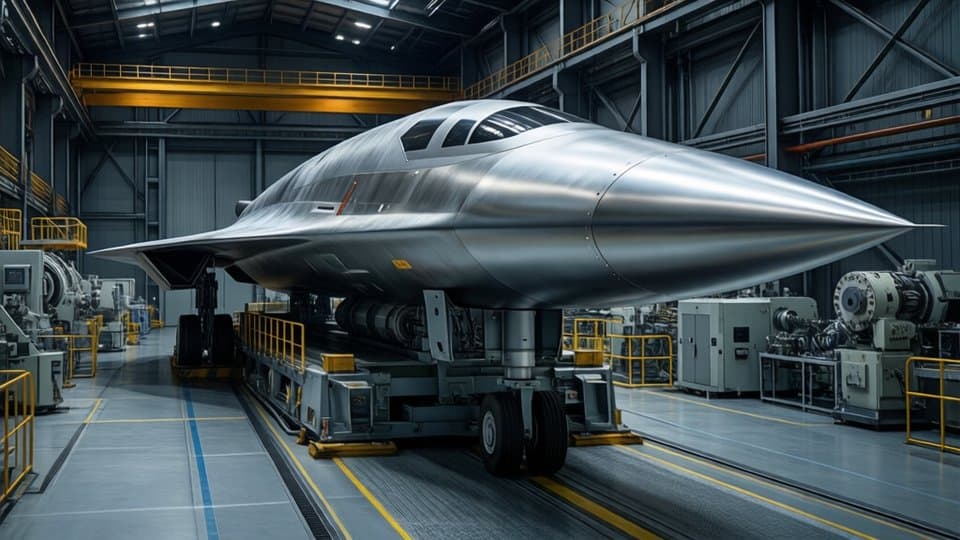
The United States military has entered a new phase of advanced weaponry production by awarding Lockheed Martin a contract worth nearly $700 million for the Air-Launched Rapid Response Weapon (ARRW). This move aims to revitalize a previously shelved hypersonic program to counter rapid advancements by Russia and China, as the Pentagon seeks to transform high-end technology into mass-produced assets. Amidst this push, the development of the dark eagle hypersonic missile continues to be a central pillar of the U.S. Army's long-range strike capabilities.
- The U.S. Army's Dark Eagle missile reached initial operational capability in April 2026, according to Eurasia Review.
- Lockheed Martin received a contract worth almost $700 million for the ARRW program, according to Newsweek.
- A single hypersonic missile could cost nearly $70 million, according to the Government Accountability Office.
Why is the U.S. accelerating hypersonic production?
The United States is shifting its strategy from experimental testing to high-rate manufacturing to close a capability gap with its primary adversaries. While the U.S. led early designs in the 2000s, it de-prioritized these efforts, allowing competitors to move ahead. This shift is driven by the need to bypass increasingly sophisticated air defense networks built by China and Russia.
The Pentagon views these weapons as having "fundamentally altered the landscape of military technology and strategy," as reported by Newsweek. To combat this, the Trump administration has advocated for increasing annual military spending to $1.5 trillion. Within this budget, approximately $38 billion would be directed toward hypersonic programs, according to congressional research cited by Newsweek.
The current focus involves several distinct programs. The U.S. Army and Navy are jointly developing the Conventional Prompt Strike (CPS) and the Long-Range Hypersonic Weapon (LRHW), which the Army officially named Dark Eagle last year. The Navy also seeks to deploy these systems from Zumwalt-class destroyers and Virginia-class submarines, though some projects like the Hypersonic Air-Launched Offensive Anti-Surface Warfare (HALO) missile were canceled in 2024 due to high costs.
How do U.S. weapons compare to Russia and China?
The U.S. currently lacks operational hypersonic weapons, whereas China and Russia have already fielded various systems. China's DF-17 has been operational since roughly 2019 or 2020, giving Beijing a significant head start, according to Eurasia Review. While the U.S. focuses on precision and non-nuclear payloads, its rivals have integrated these technologies into broader strategic arsenals.
Russia claims to possess several hypersonic capabilities, including the Avangard glide vehicle and the Zircon missile. The Zircon is reported by Russia to travel between Mach 6 and Mach 8, according to Newsweek. Additionally, Russia's Kinzhal missile is described as an air-launched ballistic weapon capable of maneuvering during flight. In November 2024, Moscow launched the Oreshnik intermediate-range ballistic missile at Dnipro, Ukraine, which Russia claims travels at hypersonic speeds.
China is moving toward next-generation air-breathing scramjet engines. In September 2025, China unveiled the YJ-19, an advanced scramjet-powered anti-ship missile that can fit into standard submarine torpedo tubes, according to Eurasia Review. The Pentagon has previously characterized Beijing as possessing the "world’s leading hypersonic missile arsenal," as noted by Newsweek.
Is the U.S. moving toward low-cost mass production?
A new development in U.S. naval strategy involves prioritizing quantity over extreme technological complexity. The "Blackbeard" hypersonic missile represents a departure from traditional high-cost designs, aiming for a unit price of approximately $500,000, according to news.qq.com. This is significantly cheaper than a Tomahawk cruise missile, which costs roughly $1.5 million.
The Blackbeard design uses a two-stage structure consisting of a solid booster and a hypersonic glide vehicle. This approach avoids the complexity of scramjet technology to keep costs low, according to news.qq.com. The Navy plans to use these missiles as "consumables" rather than rare strategic assets, with a framework agreement aiming to purchase up to 12,000 Blackbeard missiles over five years.
This strategy seeks to use volume to create survival space in the Pacific. While the Blackbeard has a limited range of 200 nautical miles, it allows F/A-18 fighters to engage targets without entering the primary air defense zones of opposing fleets. However, observers noted in news.qq.com that China's industrial capacity for low-cost precision munitions could allow it to replicate this high-volume approach.
How each side tells it
The different actors involved in the hypersonic race present vastly different views on the current state of military readiness and technological necessity.
The Pentagon emphasizes the need for defensive parity and rapid scaling. Defense Secretary Pete Hegseth has unveiled the "Arsenal of Freedom" to describe a push for churning out more U.S. weapons. Air Force Secretary Troy Meink described the decision to put the ARRW into production as a "turning point" for American advanced weaponry, according to Newsweek.
Conversely, DARPA's own communications suggest a struggle with technical breakthroughs. In a request for information, the agency admitted that previous scramjet demonstrations achieved only "predictable and incremental gains" rather than a "revolutionary leap," according to Eurasia Review. This highlights a tension between the desire for cutting-edge physics and the necessity of practical, manufacturable designs.
What is the history of the hypersonic race?
The race for hypersonic dominance is rooted in decades of research and shifting geopolitical priorities. While the U.S. has a technical pedigree dating back to the 1950s with the Pershing-II, its modern dedicated hypersonic programs only gained momentum after a period of stagnation.
Key historical points include:
- Early 2000s: The U.S. was a leader in hypersonic design but de-prioritized these efforts, according to Newsweek.
- 2018: Russian President Vladimir Putin lauded several "next generation" weapons, including the Avangard glide vehicle, in a public speech.
- 2019-2020: China's DF-17 system became operational, marking a period of rapid Chinese advancement, according to Eurasia Review.
- 2023: The U.S. Air Force moved to cancel ARRW development following testing failures, before later resurrecting the program.
- 2024: The U.S. Navy canceled the HALO missile due to rising costs, according to Newsweek.
What happens next?
The immediate future of the hypersonic race will be defined by production milestones and upcoming budget cycles. The U.S. military is currently moving from the testing phase to the "design for manufacturing" phase to ensure these weapons can be built at scale.
The U.S. Navy is working toward the 2027 fiscal year, where it has specifically allocated $156 million to purchase 353 MACE missiles as part of a broader project targeting over 4,000 units, according to news.qq.com. Additionally, the Pentagon is requesting a record defense budget for the 2027 fiscal year to fund these high-cost technologies. On the defensive side, the administration is working toward the "Golden Dome" missile shield, designed to intercept next-generation threats like incoming hypersonic missiles.
Frequently Asked Questions
What makes a hypersonic missile different from a regular missile?
Hypersonic missiles travel faster than Mach 5 and can maneuver mid-flight. This ability to twist and turn makes them much harder for traditional air defenses to intercept.
Is the United States currently winning the hypersonic race?
The U.S. is currently catching up after a period of de-prioritization. While the U.S. has advanced technology, China and Russia have already deployed operational hypersonic systems.
Why are hypersonic missiles so expensive?
These systems are complex to design and manufacture, with some costing nearly $70 million per unit. To counter this, the U.S. is now exploring lower-cost, mass-produced alternatives.