
Newzix
Breaking News
Drones & Defense Tech

Lockheed Martin Wins $694 Million Contract for New US Hypersonic Missile
Marcus Hale5 min read
Lockheed Martin Wins $694 Million Contract for New US Hypersonic Missile

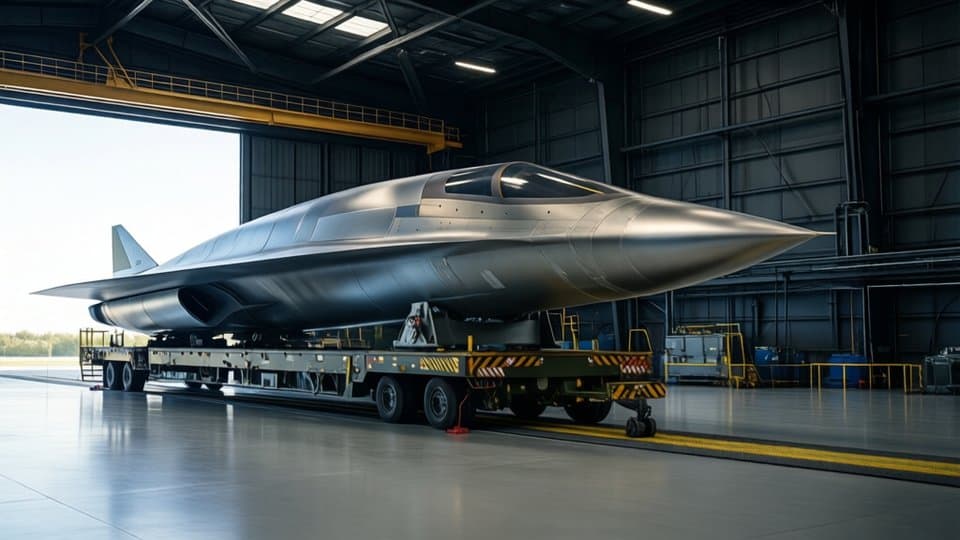
The US Air Force has awarded Lockheed Martin a $694 million contract to produce the AGM-183A Air-Launched Rapid Response Weapon (ARRW), a high-speed us hypersonic missile. This decision, announced on October 26, 2026, moves the weapon from testing into serial production after years of technical failures and budget uncertainty.

  • Lockheed Martin received the $694 million award on September 29, 2026, according to aviationtoday.in.
  • The missile is designed to fly faster than Mach 5, or five times the speed of sound, as reported by yellowhammernews.com.
  • Lockheed Martin is expanding its Troy, Alabama facility by 47,000 square feet to support this production, according to aerotime.aero.

What is the ARRW hypersonic missile?

The AGM-183A ARRW is a boost-glide weapon designed to strike high-value targets from long distances. It uses a solid-fuel rocket booster to accelerate the missile to hypersonic speeds before releasing a glide vehicle that maneuvers toward its target. This design allows launch aircraft to stay far away from heavily defended areas.

The weapon travels at speeds exceeding Mach 5. According to yellowhammernews.com, the missile uses advanced materials to survive extreme heat. Its speed and ability to maneuver are intended to make it difficult for enemy air-defense systems to intercept the projectile.

The Air Force plans to deploy the missile on the Boeing B-52H Stratofortress bomber. While the B-52H is the primary platform, armyrecognition.com notes that carriage testing has also occurred on the B-1B Lancer.

Why did the program face previous setbacks?

The ARRW program has struggled with technical failures and shifting government priorities since its development began in 2018. Early tests in 2021 were unsuccessful, including an April attempt that failed to complete its launch sequence. A July 2021 test saw the booster separate but fail to ignite its rocket motor, according to armyrecognition.com.

Funding instability also threatened the missile. In March 2023, Air Force officials stated they would not purchase the missiles, turning instead to the Hypersonic Attack Cruise Missile (HACM) program. This shift was confirmed by yellowhammernews.com, which reported that the 2025 budget request contained no procurement funding for ARRW.

The program finally saw success in 2022 with a successful flight test in May. Later, a March 2024 demonstration in Guam tested the weapon from a forward B-52H location. This test helped provide more realistic data on how the weapon would perform in actual combat zones.

How does each side describe the contract?

The US Air Force views the contract as a vital step in maintaining a technological edge. They see it as a way to provide commanders with a weapon that can bypass modern defenses. The service has not released specific details on how many missiles are being ordered to protect operational security.

"By moving ARRW from test to production, we’re providing our combatant commanders with a credible, high-speed strike weapon capable of penetrating the most advanced anti-access and area-denial systems,"

— Troy Meink, Air Force Secretary

Lockheed Martin describes the award as a validation of their manufacturing speed. The company is using the contract to justify massive investments in its Alabama facilities. They view the production move as a way to strengthen the strategic capabilities of the US military.

"The ARRW production contract award showcases Lockheed Martin’s ability to develop and begin production on cutting-edge systems at unprecedented speed and scale,"

— Tim Cahill, president of Lockheed Martin Missiles and Fire Control

How is Lockheed Martin expanding in Alabama?

Lockheed Martin is rapidly increasing its manufacturing footprint in Alabama to meet the new demand. The company is expanding Building P-20 in Troy, adding 47,000 square feet of space. This expansion will triple the current production capacity for the ARRW missile, according to aerotime.aero.

The company has already invested $67 million in this expansion and new equipment. This spending happened before the government contract was officially awarded. Lockheed Martin plans to invest between $8 billion and $9 billion through 2030 to satisfy the general demand for military munitions.

Other Alabama sites support different programs. In Courtland, the company opened a missile assembly facility in 2021 and another 88,000-square-foot facility in June 2026. These sites support the Next Generation Interceptor program and the US Navy's Conventional Prompt Strike program, as reported by yellowhammernews.com.

What is the history of the ARRW program?

The ARRW program began in 2018 through research by the US Air Force and DARPA. Initially, Lockheed Martin held a design contract worth up to $480 million. The program originally aimed to be operational by 2022, but technical issues delayed this goal.

A timeline of key events includes:

  • 2018: Program development begins.
  • April 2021: An early launch attempt fails.
  • May 2022: The first successful flight test is achieved.
  • December 2022: A full operational prototype is launched from a B-52H.
  • March 2023: The Air Force decides to halt procurement.
  • June 2025: Leadership signals a return to procurement plans.
  • September 2026: The production contract is awarded.

The program is now part of a dual-track hypersonic strategy. The Air Force is pursuing both the rocket-boosted ARRW and the air-breathing scramjet-powered Hypersonic Attack Cruise Missile (HACM). This ensures the military has different types of high-speed options for different combat scenarios.

What happens next for the program?

The immediate focus is on building the production capacity in Alabama. Lockheed Martin expects the expansion to create new jobs over the next four years. However, the exact number of missiles produced and their delivery dates remain secret for security reasons.

The US Air Force is also seeking more money to keep the program running. The fiscal 2027 budget request includes $452 million for ARRW production. This request must still pass through Congress. According to aviationtoday.in, future annual spending could reach up to $621 million between 2028 and 2031.

The success of the program will depend on how quickly these missiles can be integrated into the B-52H fleet. If the production ramp-up meets expectations, the ARRW will become a standard part of the US strategic arsenal within the next few years.

Frequently Asked Questions

How fast does the ARRW missile travel?
The missile is designed to fly at hypersonic speeds, which means it travels faster than Mach 5, or five times the speed of sound.

Which aircraft will carry the ARRW missile?
The Boeing B-52H Stratofortress is the primary launch platform, though testing has also been performed with the B-1B Lancer.

Where is the missile being manufactured?
Lockheed Martin is producing the missiles at its facilities in Alabama, specifically expanding a production building in Troy.

Sources

  1. 1.aviationtoday.inUS Air Force Awards Lockheed Martin $694 Million Contract For ARRW Hypersonic Missile
  2. 2.aerotime.aeroUS Air Force puts Lockheed Martin’s troubled hypersonic ARRW into production
  3. 3.armyrecognition.comU.S. Air Force revives AGM-183A ARRW hypersonic missile with $694 million production contract.
  4. 4.yellowhammernews.comLockheed Martin lands $694 million Air Force contract to expand Alabama manufacturing at ‘unprecedented speed and scale’

Read more →

Related Articles

Mercedes CLA L for China: Poor Sales Lead to Production Halt
China & Taiwan

Mercedes CLA L for China: Poor Sales Lead to Production Halt

The extended electric sedan Mercedes‑Benz CLA L , specially developed for the Chinese market, has turned out to be a commercial disappointment: according to industry sources, only 627 units were sold in China in the first half of 2026, after which production of the model at the Beijing Benz plant was temporarily suspended. There is no official confirmation of the production stop from Mercedes‑Benz yet, however, several specialized publications, citing internal sources and sales statistics, agree that the CLA L project in its current form has not met the concern's expectations. A Model "For China Only": Extended Wheelbase and Adapted Software The CLA L is an exclusive version for the Chinese market of the new electric Mercedes‑Benz CLA with an extended wheelbase by 40 mm and an overall length increased to approximately 4.76 m. This configuration is traditionally in demand in the PRC, where many manufacturers offer "long" versions of sedans and crossovers for more space for rear-seat passengers. The model is equipped with a battery capacity of about 89 kWh and boasts a range of up to 866 km in the Chinese CLTC cycle, formally making it one of the "longest-range" cars in its segment. The CLA L also received a software suite adapted for the local market, including advanced artificial intelligence functions and fast charging, designed to compete with local tech brands. The production of the sedan was carried out at the facilities of the joint venture Beijing Benz Automotive —a joint venture between Mercedes‑Benz and China's BAIC Motor, responsible for the production of a number of premium models for the domestic market of the PRC. Sales Statistics: A Sharp Spike and a Crash to Zero The main reason for the conveyor belt stoppage was the extremely low sales volumes in the world's largest electric vehicle market. According to MBPassion, cited by Carscoops and a number of European media outlets, dealers managed to deliver only 627 CLA L cars in the first half of 2026. The monthly dynamics are as follows: January — 35 cars; February — 21 cars, a minimum for the period; March — a short-term spike to 358 units; April — a drop to 52; May — 161 cars; June — according to some sources, 0 new registrations . It was the data on zero June sales that led to loud headlines about the model's "failure" and a "symbol of the crisis" in Mercedes' electric car sales in China. At the same time, some Chinese statistical reports still record minor registrations, indicating possible discrepancies in accounting methodology and continuing uncertainty. Temporary Pause: What is Known About the Production Stop A number of European and Asian publications, including MBPassion and Highmotor, report a temporary suspension of CLA L assembly at the Beijing Benz plant in Beijing. It is noted that at such a level of demand, mass production loses its economic sense, and further production risks an oversupply of inventory. Mercedes‑Benz has not publicly confirmed either the fact of the production stoppage or the possible timing of its resumption, leaving the question of the model's future open. According to MBPassion, a complete withdrawal of the CLA L from the market is not ruled out if the demand assessment proves to be consistently erroneous and the situation cannot be reversed. Thus, the current status of the project can be described as "frozen": formally, the model remains in the lineup, but its production, according to specialized sources, has been paused due to sales not meeting initial forecasts. Why the "Chinese" CLA Didn't Become a Hit Analysts attribute the weak interest in the CLA L not to its technical characteristics, but to the general change in the competitive environment in the PRC electric vehicle market . German publications note that it is becoming increasingly difficult for Mercedes‑Benz to compete with local brands such as Xiaomi, Nio, BYD, XPeng, and others, which offer aggressive pricing, deep integration of digital services, and rapidly updated model lineups. Against the backdrop of local manufacturers focused on online sales and ecosystems of "smart homes" and mobile services, even the premium status of the Mercedes brand no longer guarantees success in the mid-price segment of electric sedans. At the same time, the CLA L is positioned as technologically advanced, but at the initial sales launch, prices comparable to some mass-market models were reported, which should have made it competitive in terms of "image/cost" ratio. A separate problem is the possible mismatch between the product and the expectations of the Chinese audience: the extended wheelbase and spacious rear row have become market standards, and the key factor in choice is increasingly the design of interfaces, the quality of built-in services, local super-apps, and "smart" functions, in which new Chinese brands are moving faster than traditional automotive concerns. Implications for Mercedes‑Benz's Strategy in China The unsuccessful launch of the CLA L is seen as an indicator of a broader problem: the transition of power in the PRC electric vehicle market to local players , even in segments historically dominated by European premium brands. For Mercedes‑Benz, this is a signal of the need to revise its product and pricing strategy, as well as to adapt the digital part of the car to local user habits. At the same time, the failure of one model does not mean the concern's withdrawal from the Chinese market. The company continues to develop production through joint ventures, expand its electric lineup, and test different formats of cooperation with local IT players. However, the CLA L case, created "for China" and proving to be in demand, has already become an illustrative example of the risks when attempting to finely adapt a global platform to a hyper-dynamic market.

Sara Lindqvist·
Public Opinion Split Amidst Impeachment of South Korea President Lee's Judicial Push
East Asia

Public Opinion Split Amidst Impeachment of South Korea President Lee's Judicial Push

Public opinion in South Korea is deeply divided regarding the possible impeachment of South Korea president Lee Jae-myung's administration's push to remove Supreme Court Chief Justice Cho Hee-dae. Recent polling shows that while President Lee's approval rating has climbed back to the 40% range for the first time in seven weeks, the nation remains split on whether to remove the top judge. What is the current approval rating for President Lee? President Lee Jae-myung has seen a stabilization in his public standing, with his positive rating reaching 40% in recent days. This marks a recovery from a post-inauguration low of 37% and suggests a halt to a continuous downward trend. According to Gallup Korea , conducted from October 20 for three days: 40% of the 1,001 adults surveyed responded that President Lee was performing his state affairs well. However, 50% of respondents felt he was performing poorly. This data indicates that while the president has gained momentum, a significant majority still views his performance negatively. The reasons for these ratings vary by category. For those favoring the president, Gallup Korea reported that 21% cited diplomacy as a reason for their positive view, followed by 14% for the economy and livelihoods, and 7% for communication. Conversely, negative assessments were driven by real estate policy at 18% , the economy at 16% , and national security/North Korea policy at 10% . Is there support for the impeachment of Chief Justice Cho? The question of whether to remove Chief Justice Cho Hee-dae has split the electorate almost down the middle. While the ruling Democratic Party is pushing for the move, the general public is not yet in consensus. According to Gallup Korea : 34% of respondents support the impeachment of Chief Justice Cho Hee-dae. 39% of respondents oppose the impeachment. 28% of respondents reserved judgment or refused to answer. The difference between support and opposition falls within the margin of error. This suggests that the political push for removal lacks a clear mandate from the broader public. How do different political groups view the impeachment? Support for the impeachment is heavily dictated by party affiliation and political leaning. The push is most visible among the president's core supporters but faces resistance from the opposition and centrist voters. The breakdown of support for the impeachment of the Chief Justice is as follows: Democratic Party supporters: 61% favor impeachment. People Power Party supporters: 71% oppose impeachment. Progressives : 66% support impeachment. Conservatives : 61% oppose impeachment. Moderates : Split evenly at 34% for both support and opposition. The Korea Herald notes that although the Democratic Party leads the People Power Party by 9 percentage points in general party support, it has failed to win over the political center regarding the judge's removal. How each side tells it The debate over the judiciary is characterized by intense disagreement between the ruling bloc and the opposition parties regarding the necessity of the move. The Democratic Party and the Rebuilding Korea Party are actively driving the impeachment process. The Rebuilding Korea Party has taken a more aggressive stance by releasing a draft impeachment motion and proposing a joint task force to move the process forward. The Democratic Party, however, remains divided. According to the Korea Herald , internal disagreements persist within the Democratic Party concerning both the necessity of the impeachment and the specific timing of any legislative action. What is the historical context of impeachments in Korea? Impeachment is a known political mechanism in South Korea, though successful motions against high-ranking officials are relatively rare and carry significant weight. To understand the current climate, one must look at previous instances where the public was asked to weigh in on high-level removals. According to Gallup Korea , a February 2023 survey regarding former Minister of the Interior and Safety Lee Sang-min showed a much higher level of consensus. In that instance, which involved the handling of the Itaewon disaster, support for impeachment was significantly higher: 82% of Democratic Party supporters supported impeachment. 72% of progressives supported impeachment. 51% of moderates supported impeachment. The current consensus regarding Chief Justice Cho is notably narrower than the consensus seen during the Lee Sang-min case. What happens next for the administration? The administration faces a dual challenge of managing a divided legislature and a cautious public while attempting to stabilize the economy. The Democratic Party and the Rebuilding Korea Party continue their discussions regarding the impeachment motion. While no specific date for a vote has been set, the Rebuilding Korea Party is actively pressing the Democratic Party to act on their proposed draft. Meanwhile, the president's ability to govern will depend on his ability to manage the National Assembly and address economic pessimism, as only 27% of respondents expect the economy to improve over the next year. FAQ Why is there a push to impeach the Chief Justice? The Democratic Party and the Rebuilding Korea Party are discussing the impeachment, with the latter having already released a draft motion, though specific reasons for the move are not detailed in current polling reports. Is the public in favor of removing the Chief Justice? No, the public is split. Recent polling shows 34% support impeachment while 39% oppose it, a difference that sits within the margin of error. How is President Lee's approval rating performing? His approval rating has risen to 40%, which is the highest it has been in seven weeks, though his negative rating remains higher at 50%.

Tomas Vogel·
Tech Leaders Block AI Oversight as National Security Alarms Sound
Chips & Rare Earths

Tech Leaders Block AI Oversight as National Security Alarms Sound

Tech giants and political figures are currently embroiled in a high-stakes struggle over the future of artificial intelligence regulation and national security. The recent successful lobbying efforts by Silicon Valley leaders to block new oversight agencies have sparked concerns regarding intelligence agency warnings and the potential for compromised leadership within the United States government. Nvidia CEO Jensen Huang, Meta CEO Mark Zuckerberg, and SpaceX CEO Elon Musk successfully lobbied President Donald Trump to shelve plans for an AI regulatory agency, according to news.qq.com . Intelligence agencies reportedly warned the Trump administration about a national security threat involving Nvidia CEO Jensen Huang, but the administration did not act, according to eaworldview.com . The Trump administration's current stance prioritizes industrial competitiveness through a "minimum regulation" approach, according to news.qq.com . Why is there a conflict over AI regulation? The conflict centers on a proposal to create a private-sector-led regulatory body for artificial intelligence, similar to the Financial Industry Regulatory Authority (FINRA) used in the US financial sector. This model was suggested by Google DeepMind head Demis Hassabis to allow the industry to set its own standards and avoid heavy government intervention. However, major tech leaders have fought this concept. news.qq.com reports that Jensen Huang, Mark Zuckerberg, and Elon Musk expressed direct opposition to the plan to President Trump. They argue that such an agency could become a "power club" for dominant firms like OpenAI, Anthropic, and Google, leaving the industry's future in uncertain hands. The White House remains divided on the issue. While Chief of Staff Susie Wiles and Cyber Director Sean Kennemore favored stricter frameworks, David Sacks, the Director of the White House Office of Science and Technology Policy, pushed for minimal regulation. This internal debate has shaped the current lack of a formal oversight mechanism. What are the national security concerns regarding Nvidia? Serious allegations have emerged regarding the intersection of corporate interests and national security. Reports from eaworldview.com suggest that Nvidia CEO Jensen Huang was compromised by an affair with a Chinese spy. This personal situation reportedly led to Nvidia circumventing United States restrictions on providing chips to China. The report claims that despite warnings from intelligence agencies, the Trump administration—specifically Commerce Secretary Howard Lutnick and President Trump—failed to take action against this threat. These allegations tie into a broader discussion of corruption within the Trump inner circle. The situation highlights how the decimation of government regulation may allow political figures and their families to profit from their offices while potentially undermining national security protocols. How do the different sides view AI governance? The debate over AI governance has created a massive divide between different global powers and even within the United States itself. The current American approach focuses on maximizing industrial speed and hardware dominance rather than establishing strict legal guardrails. The positions are clearly defined by the players involved: "Safety is the highest priority, but safety is also an engineering challenge; speed and safety can coexist," said Jensen Huang, Nvidia CEO. According to news.qq.com , Mark Zuckerberg believes corporations have the responsibility and ability to set their own development pace without external interference. Conversely, leaders like Dario Amodei of Anthropic have called for a slowdown in AI development to ensure safety. On the global stage, the United States is moving toward a "free fall" in regulation compared to other regions. The European Union is implementing the AI Act, and China has introduced measures for algorithm filing and security assessments. This creates a fragmented global landscape where companies must navigate vastly different rules depending on their market. How does this affect the satellite and chip industries? The absence of regulation acts as an accelerator for the computing power supply chain. Because there is no oversight on model training scales or algorithmic audits, companies are incentivized to engage in an unrestrained race for hardware. This directly benefits Nvidia, whose performance relies on the massive expansion of GPU clusters and data centers. SpaceX also stands to gain from this regulatory vacuum. As Elon Musk integrates AI with the Starlink satellite constellation, the lack of clear rules for AI-driven satellite operations allows for greater technical freedom. This includes using AI for beam scheduling and autonomous collision avoidance without immediate compliance pressures. However, this "wild growth" phase could lead to significant risks. Without standardized rules for how AI manages space traffic or handles cross-border data, the industry may face sudden, massive public backlash if a major AI-related accident occurs in orbit. What is the status of Pete Hegseth and political stability? Political tensions are rising as the administration faces scrutiny over its appointments and internal conduct. Pete Hegseth recently avoided impeachment on a Wednesday night, but this is viewed by some analysts as merely an opening act in a larger political struggle. The political landscape is expected to shift significantly in January. According to eaworldview.com , Democrats are expected to take control of both the Senate and the House, which will likely lead to renewed investigations and impeachment attempts. There are also concerns regarding the administration's foreign policy. Envoys such as Steve Witkoff and Jared Kushner are being watched closely to see if they will support the defense of Ukraine or move toward backing the Kremlin, potentially altering the course of the Russia-Ukraine conflict. What happens next? The following events and timelines will determine the direction of AI policy and political accountability: January 2027: Democrats take control of the U.S. Senate and House, likely triggering new oversight and impeachment proceedings. Ongoing: The expansion of AI-integrated satellite networks like Starlink under current minimal regulatory conditions. Future: Potential intelligence or congressional investigations into the relationship between Nvidia's leadership and Chinese interests. Frequently Asked Questions Why are tech CEOs lobbying against AI regulation? Leaders like Elon Musk and Mark Zuckerberg argue that regulation could become a "power club" for a few dominant companies and that industry-led standards are more efficient than government rules. What is the risk of minimal AI regulation? A lack of oversight may lead to an unregulated "arms race" in computing power and could result in safety accidents in critical sectors like satellite communications. How does this impact the US-China relationship? The divergence in regulation creates a fragmented global market, where the US prioritizes industrial speed while China and the EU focus on stricter algorithmic and safety controls. SEO Meta Description: Tech giants Nvidia, Meta, and SpaceX successfully lobbied to block US AI regulation, sparking national security concerns and political tension. URL Slug: nvidia-meta-spacex-ai-regulation-trump-security

Grace Lin·