
Hundreds Dead and Thousands Missing After Massive Glacial Collapse in Himalayas
A catastrophic flash flood and mudslide struck the Nepal-Tibet border on Wednesday, August 26, 2026, killing hundreds of people and leaving over a thousand others missing. The disaster swept away entire villages, destroyed critical infrastructure, and sent a wall of debris through remote mountain valleys, affecting both sides of the international border.
- Nepali police reported recovering 389 bodies as the death toll rose sharply, according to The Daily Star.
- China's state broadcaster CCTV reported that at least 3 people died in Tibet, with 265 people still missing, according to dw.com.
- The US Geological Survey identified the cause as a magnitude 5.2 glacier collapse that triggered the catastrophic debris flow, according to Weather.com.
What caused the deadly surge of water and mud?
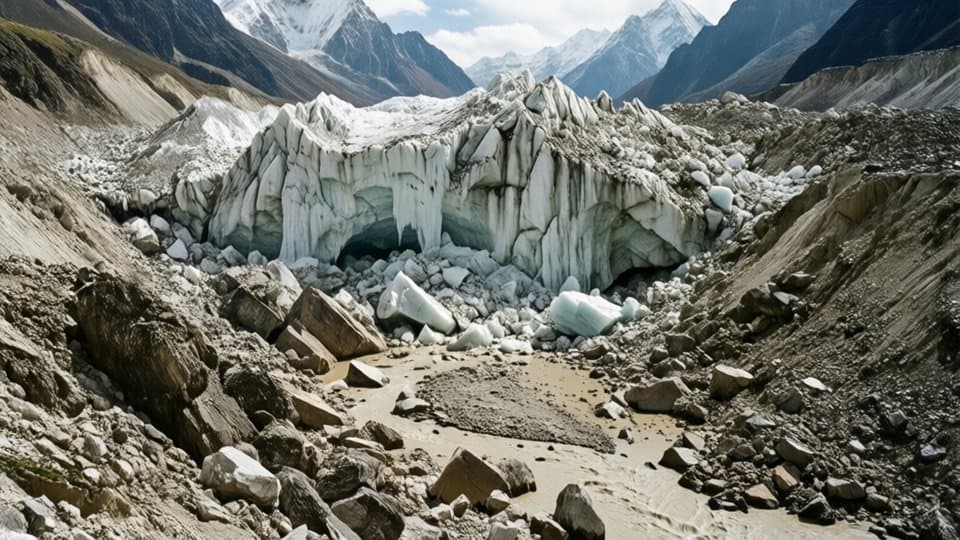
Scientists believe a massive glacial collapse triggered the disaster. The US Geological Survey reported that a magnitude 5.2 glacier collapse sent debris flowing downstream, creating a catastrophic impact on communities in both Nepal and Tibet, according to Weather.com.
Preliminary investigations suggest a large chunk of a glacier broke off and potentially dammed a river. This caused water to back up before surging downstream with extreme force. Researchers at the International Centre for Integrated Mountain Development noted that river water levels rose by as much as 9 meters (29.5 feet) in just 30 minutes, according to Weather.com.
Geoscientist Jakob Steiner explained the mechanism of the collapse. He noted that the imagery looks as if a huge knife cut through the lower part of a glacier, causing it to fall off. This event could have felt like a bomb exploding, according to Weather.com.
How many people are missing or dead?
The death toll and number of missing persons vary depending on the source and the timing of the reports. Reports indicate a massive scale of human loss across the Himalayan region. The disaster has heavily impacted both local residents and international travelers.
Data on the casualties shows significant discrepancies between different news outlets and agencies:
- The Daily Star reported the death toll rose to at least 392, with more than 1,400 people missing.
- Dawn reported that at least 362 people died and around 1,000 were missing as of Thursday evening.
- dw.com cited Nepali police saying they recovered 157 bodies.
- China's state news agency Xinhua reported that the number of missing people in China reached 558, according to dw.com.
Many of the missing are foreign tourists. The Nepal Tourism Ministry reported 403 travelers missing, including 142 from India and 47 from the United States, according to dw.com. Other missing nationalities include citizens from Australia, Britain, Canada, Malaysia, and South Korea.
How much damage was done to the region?
The flood and mudslide destroyed critical infrastructure and wiped out entire settlements. The impact was felt most heavily in the Rasuwa district of Nepal and Gyirong County in Tibet. The destruction has cut off remote communities from essential services.
In Tibet, the mudslide hit the Gyirong border crossing, a key part of China's Belt and Road network. Surveillance footage showed a wall of mud crashing over buildings and sweeping away vehicles, according to Dawn. All buildings in the border-crossing complex, including the customs and immigration agencies, were destroyed.
In Nepal, the devastation was equally severe. The floodwaters damaged bridges, destroyed electrical infrastructure, and washed away villages. The Red Cross stated that entire settlements next to the river were completely swept away, making roads and bridges impassable, according to dw.com. Even 100 km away in the Chitwan district, authorities recovered 103 bodies from the river system, according to The Daily Star.
How are the governments responding?
Both the Nepali and Chinese governments have launched major rescue operations. Leaders from both nations have issued statements promising full support for the victims and their families. The scale of the disaster has prompted high-level political intervention.
Nepal Prime Minister Balendra Shah visited hard-hit areas and urged the nation to stand together. He stated the government takes full responsibility for rescue, food, and shelter. He also instructed authorities to move people in flood-risk areas to safer locations, according to dw.com.
In China, President Xi Jinping ordered an "all out" rescue effort. He emphasized that the most urgent task is to search for the missing and treat the injured, according to dw.com. Chinese Premier Li Qiang also arrived at the disaster site in Gyirong to oversee the response, according to The Daily Star.
"The pain and loss you have suffered is not small. But I want to assure you that you are not alone in this difficult time — the state is with you with all its means and resources,"
— Balendra Shah, Nepal Prime Minister
Is there a risk of more flooding?
Experts warn that the danger has not passed. A significant threat remains because of the debris left behind by the initial landslide and flood. This blockage could lead to a secondary disaster if the trapped water breaks through.
Qianggong Zhang, head of climate and environmental risks at the International Centre for Integrated Mountain Development, warned that a second flood may occur because a blockage is still lodged upstream on the Nepal-China border river, according to dw.com. Kathmandu’s Flood Forecasting Division issued a special notice to residents of the Bhote Koshi River area to exercise extreme caution.
The risk is linked to the changing climate in the Hindu Kush Himalaya region. While scientists say it is too early to link this specific event to global warming, they note that rising temperatures are causing glaciers to melt at an accelerating rate. This melting increases the likelihood of glacial lake outbursts and sudden debris flows, according to Weather.com.
What happens next?
Rescue and recovery efforts will continue through the coming days. Search teams are using sniffer dogs to find bodies buried under mud in Nepal, according to The Daily Star. Authorities are also working to clear debris from the Gyirong border crossing to allow more aid to reach the affected areas in Tibet.
Monitoring of the river systems will remain a top priority to prevent a second flood. The International Federation of Red Cross and Red Crescent Societies is sending emergency supplies, including blankets and body bags, to assist the local populations, according to dw.com. Governments will also need to address the long-term reconstruction of destroyed villages and critical infrastructure like hydropower dams and roads.
FAQ
What caused the floods in Nepal and Tibet?
The disaster was caused by a magnitude 5.2 glacial collapse that sent a massive flow of ice, rock, and mud downstream.
Are there still risks of more flooding?
Yes, authorities warn a second flood could happen because debris is currently blocking the river upstream.
How many people are missing?
Reports vary, but estimates suggest between 558 and 1,400 people remain missing across both sides of the border.
Sources
- 1.dw.comDeadly flash flood wipes away villages in Nepal, Tibet
- 2.thedailystar.netHundreds feared dead in Nepal flash floods
- 3.dawn.comIn pictures: Aftermath of deadly Nepal-Tibet floods that killed over 360
- 4.weather.comHow did the deadly flood disaster in Nepal and Tibet happen? Here's what scientists are saying