US Military Speeds Up Hypersonic Weapon Production to Counter Rivals
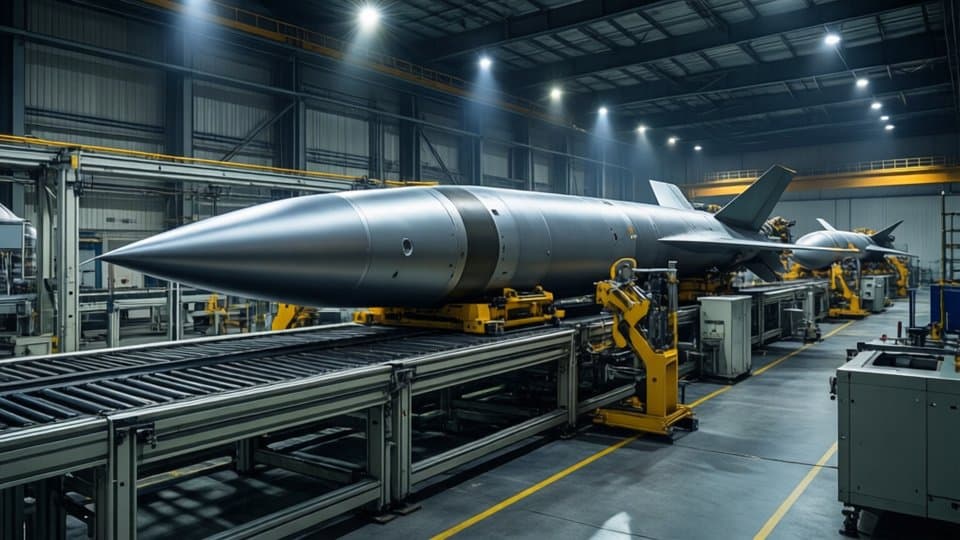
The United States military is accelerating the production of several hypersonic weapon systems to close a technological gap with Russia and China. Recent contracts involving the Army and Navy highlight a shift toward manufacturing maneuverable, high-speed warheads capable of exceeding Mach 5 to strike distant targets.
- The Navy issued a $200 million production order for Blackbeard hypersonic missiles in mid-September, according to Military.com.
- General Atomics will produce components for the Common Hypersonic Glide Body through 2031, as reported by National Interest.
- The Blackbeard missile aims to cost below $500,000 per unit, according to SlashGear.
What are the new hypersonic programs?
The United States is currently pursuing multiple distinct hypersonic paths to ensure it can strike land and maritime targets with extreme speed. These programs involve different types of flight profiles, including glide vehicles that maneuver through the atmosphere and cruise missiles.
One primary effort is the Common Hypersonic Glide Body (CHGB), a joint project for the Army and Navy. According to National Interest, this unpowered warhead will serve as the payload for the Army's Dark Eagle Long-Range Hypersonic Weapon and the Navy's Conventional Prompt Strike (CPS) program. The CHGB uses a two-stage solid-fuel rocket booster to reach high altitudes before the glide body separates to maneuver toward its target.
Another significant development is the Blackbeard, a hypersonic strike weapon created by the startup Castelion. SlashGear reports that the Navy is testing this missile on F/A-18E/F Super Hornet fighter jets. Unlike the heavy boost-glide systems, Blackbeard is designed to be an inexpensive, mass-producible option for aircraft and ground-launched systems.
How do these weapons differ from traditional missiles?
Hypersonic weapons are defined by their ability to travel at speeds exceeding Mach 5, which is more than 3,800 mph. While traditional ballistic missiles follow a predictable arc, hypersonic weapons can change direction during flight, making them much harder for defense systems to track.
The CHGB consists of a warhead, a guidance system, and a thermal protection shield designed to survive the intense heat of atmospheric re-entry. As National Interest notes, the vehicle travels along a non-ballistic, maneuvering trajectory. This capability allows the weapon to dodge interceptors that rely on calculating a fixed flight path.
Cost is another major differentiator in current development. While the GAO suggests hypersonic missiles could cost nearly $70 million each, the Blackbeard program seeks a much lower price point. SlashGear states that Blackbeard could cost under $500,000 per missile, significantly less than the $1 million to $5.35 million range for current precision strike munitions.
Why is the U.S. rushing these developments?
The United States is attempting to catch up to adversaries that have already integrated hypersonic weapons into their active military inventories. Russia and China have developed various types of these systems to neutralize American defensive advantages.
Russia has deployed several systems, including the Avangard glide vehicle and the Zircon ship-launched missile. Newsweek reports that the Zircon is capable of traveling between Mach 6 and Mach 8. Additionally, the Kinzhal missile is described as an air-launched weapon capable of maneuvering during flight.
The U.S. military faces pressure to rebuild its stocks and modernize its arsenal. According to Newsweek, the Trump administration has requested a $1.5 trillion defense budget, with approximately $38 billion of that intended for hypersonic programs. This funding aims to counter the threat posed by "next-generation" weapons from competitors.
How each side tells it
The development process involves complex coordination between government agencies and private contractors, with different emphasis placed on speed of delivery versus technological complexity.
The Navy emphasizes the need for rapid, agile acquisition to get weapons to sailors quickly. In a statement cited by Military.com, Vice Adm. John “Doc” Dougherty IV said:
"To win in contested environments, we must deliver lethality at scale inside the operational window of relevance. This production award is a testament to what is possible when the Navy aligns agile acquisition with commercial manufacturing discipline."
Conversely, the industry perspective focuses on the continuity and reliability of the manufacturing process. Mike Rucker, vice president of GA-EMS Weapons Programs, told National Interest:
"Our expertise spans cable assemblies for the Elevon Control Module and hypersonic glide body, along with precision-machined metal parts and substructures. For our customer, this combination brings continuity across electrical and mechanical manufacturing from a team familiar with the program’s exacting requirements."
What is the history of these programs?
The pursuit of hypersonic technology in the U.S. has seen periods of high investment followed by significant setbacks and cancellations.
In the early 2000s, the United States led the field in hypersonic design research. However, Newsweek reports that the U.S. eventually de-prioritized these efforts, allowing competitors to move ahead. This lull in development is part of why the U.S. currently lacks operational hypersonic weapons in its inventory.
Recent years have seen a "stop-start" process for several programs. For example, the Air Force considered canceling the Air-Launched Rapid Response Weapon (ARRW) in 2023 following testing failures. Meanwhile, the Navy cancelled its Hypersonic Air-Launched Offensive Anti-Surface Warfare (HALO) missile in 2024 due to high costs, according to Newsweek.
What happens next?
The immediate future of these programs focuses on moving from prototype testing into full-scale production and operational deployment.
The Blackbeard program has specific production milestones. SlashGear reports that the Navy aims to produce 50 missiles by August 2028. The goal is to reach early operational capability on F/A-18 Super Hornets by 2027.
For the joint Army-Navy program, General Atomics will continue manufacturing components for the Common Hypersonic Glide Body through at least 2031. The Army is also pushing its own separate technology, with Military.com noting that the Lockheed Martin contract for the Precision Strike Missile (PrSM) Increment 2 is moving into production following successful flight tests in August.
Frequently Asked Questions
What is the difference between a hypersonic missile and a ballistic missile?
A ballistic missile follows a predictable path through space, while a hypersonic missile can maneuver and change direction within the atmosphere. This makes hypersonic weapons much harder for air defense systems to intercept.
Which countries currently have hypersonic weapons?
Russia and China are noted as having various types of hypersonic missiles already in their inventories. The United States is currently in the testing and production stages for its own versions.
Why are hypersonic weapons so expensive?
They require advanced thermal protection to survive extreme heat and highly complex guidance systems to manage high-speed maneuvering. Some estimates suggest they could cost as much as $70 million per unit.
Sources
- 1.nationalinterest.orgDevelopment of This Joint US Army-Navy Hypersonic Weapon Is Moving Forward
- 2.slashgear.comThe US Navy Is Testing A New Hypersonic Missile On The F/A-18 Super Hornet
- 3.military.comArmy, Navy Tout Over $1.2 Billion in New Missile and Drone Acquisitions
- 4.newsweek.comHow US Hypersonic Missile Program Compares to Russia, China As Deal Struck