Newzix
Breaking News
Drones & Defense Tech

German troops conduct first tactical tests of loitering munitions in Lithuania
Marcus Hale6 min read
German troops conduct first tactical tests of loitering munitions in Lithuania

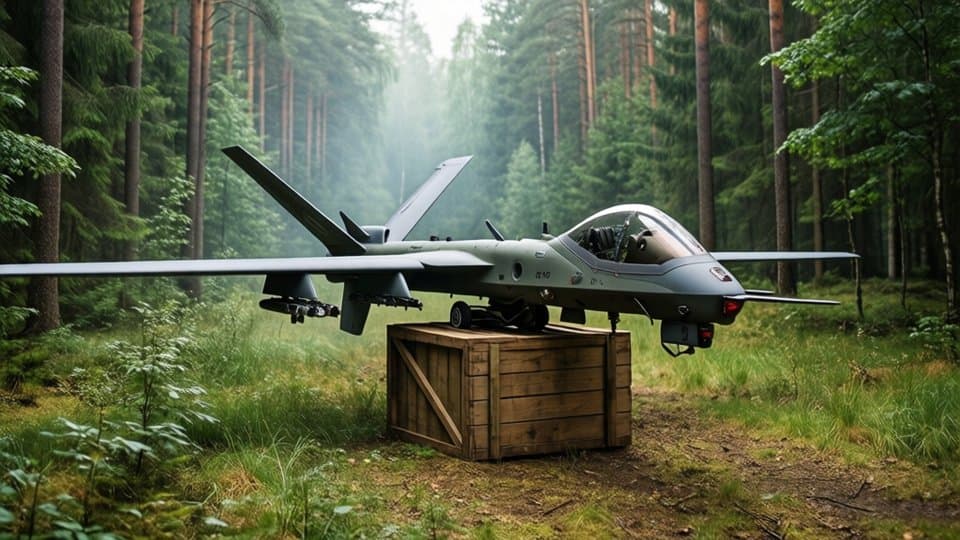
German soldiers conducted the first tactical tests of Helsing and Stark loitering munitions at the Rūdninkai training ground in Lithuania on Sunday, November 23, 2026. The exercise, held about 12 miles from the Belarusian border, marks a major step in Berlin's efforts to modernize its military for NATO's eastern flank. These one-way drones dive into targets after circling an area, and this test involved actual troops operating the systems rather than contractors.

  • German troops launched Stark's Virtus and Helsing's HX-2 munitions using inert warheads, according to sofx.com.
  • The Freedom Shield exercise included approximately 3,800 soldiers from eight NATO countries, as reported by sofx.com.
  • Germany's budget committee approved roughly 536 million euros for these drones in February, according to c4isrnet.com.

What happened during the Lithuanian military drills?

The German 45th Panzer Brigade used the loitering munitions to strike simulated armored targets, including main battle tanks and infantry fighting vehicles. These drones were part of the Freedom Shield 26-2 exercise, which sofx.com identified as the largest German military exercise held in Lithuania to date. The testing focused on the tactical application of the weapons in a field environment.

Soldiers operated the drones themselves, which is a change from previous trials where manufacturer staff handled the controls, according to defense journalist Thomas Wiegold. The brigade utilized about 100 of these munitions during the drill. Targeting data for the strikes was provided by Falke reconnaissance drones, which is the Bundeswehr's name for the Quantum Systems Vector.

Brigadier General Christoph Huber, the brigade commander, noted the increasing scale of drone use. He stated he had about 700 drones of all types for the exercise, which is an increase from roughly 300 seen in the spring. He remarked, "First contact is always unmanned."

How does the AI targeting work?

The German military tested Helsing's Clarity artificial intelligence platform alongside the drone strikes. This software is designed to process massive amounts of data from various sources, including satellites, drones, and other sensors. The system provides real-time analysis to help commanders make decisions on the battlefield, as reported by ilkha.com.

Helsing stated that the Clarity tool helps identify and assign targets, but a human operator maintains the final decision-making authority. While the AI sifts through data to find targets, the human remains in the loop. This process is intended to support operational assessments and rapid decision-making during combat.

Questions remain regarding the reliability of these systems under electronic warfare conditions. While the exercise included electronic warfare components, neither the Army nor journalist Thomas Wiegold confirmed if the strike drones actually flew against active jamming. Wiegold noted that whether the link to the drone holds in combat once jamming occurs remains an open question.

Did the drones pass their technical tests?

Both the Stark Virtus and the Helsing HX-2 passed live-fire tests during the week of November 9 at the Bundeswehr's proving ground in Meppen. The German military procurement office confirmed that both systems reliably hit their targets and that the warheads detonated as designed, according to sofx.com. However, the office did not release specific hit counts or success rates.

The HX-2 has previously shown performance under jamming in different settings. During the U.S. Army's Project Flytrap exercise in Lithuania in May, 17 HX-2 sorties resulted in 15 hits and two near misses while tracking targets under jamming, according to Axios. This data was provided by Army chief technology officer Alex Miller.

Despite these recent successes, the systems are not yet fully qualified for service. The Bundeswehr has cautioned that actual battlefield success rates can be much lower than what is seen in strike footage. The procurement office stated that the systems must still undergo thorough testing regarding how various components interact before they are officially certified.

What is the history of these drone programs?

The procurement of these loitering munitions follows years of political debate in Germany regarding the use of armed drones. The decision to move forward with these specific systems was made in 2025. This shift is part of a larger effort to modernize the German military following the 2022 Russian invasion of Ukraine.

The Stark Virtus system has faced challenges in earlier evaluations. In October 2025, the Virtus missed its target on all four attempts during trials observed by British and German evaluators, as first reported by the Financial Times. This earlier failure occurred well before the recent successful live-fire tests in Meppen.

Funding for the program is substantial. In February, Germany's budget committee approved approximately 536 million euros for the drones. This includes roughly 269 million euros for Helsing and 269 million euros for Stark. These costs are part of a seven-year framework worth about 4.3 billion euros.

How will the German Army deploy these weapons?

The German military is using a strategy of concurrent development and testing to speed up deployment. By bringing soldiers into the testing phase early, the procurement office aims to use troop feedback to improve the systems. This approach intends to reduce the time between signing a contract and getting weapons to the front lines.

The 45th Armored Brigade in Lithuania is scheduled to be the first unit to field these munitions. This deployment is part of a plan to establish a permanent 5,000-strong armored brigade in Lithuania by the end of 2027. This would be Germany's first long-term overseas combat brigade deployment since the Second World War, according to ilkha.com.

The brigade will eventually consist of approximately 5,000 troops and 2,000 vehicles, including many main battle tanks. Currently, about 1,800 German soldiers are already stationed in Lithuania as part of the ongoing deployment process. The presence of the brigade is intended to strengthen NATO's eastern flank near the Suwałki Gap.

What happens next for the program?

The immediate focus is on training and initial deliveries. The procurement office expects the first deliveries of the drones to arrive before the end of 2026. These initial batches will allow soldiers to begin the necessary training before the systems are officially integrated into combat units.

The 45th Armored Brigade is slated to become the first major formation to receive the munitions in 2027. At that time, the brigade is planned to reach its full strength of 5,000 troops. The military intends to link the loitering munitions with its existing reconnaissance and strike systems to create a more integrated battlefield capability.

Lawmakers have maintained strict oversight of the spending. They attached specific reporting requirements to the budget and included cancellation clauses. These clauses allow the German government to terminate the contracts if the systems fail to meet final qualification standards during the remaining testing phases.

Frequently Asked Questions

What are loitering munitions?
They are one-way drones that can stay airborne over a specific area to search for targets before diving into them. They act as a combination of a drone and a missile.

Are these drones fully autonomous?
No, while they use AI to help find targets, a human operator is required to make the final decision to strike. The AI processes data to provide recommendations to commanders.

When will German troops use these in combat?
The 45th Armored Brigade is expected to start fielding the munitions in 2027. Initial deliveries for training are expected to arrive by the end of 2026.

SEO Meta Description: German troops tested Helsing and Stark loitering munitions near the Belarus border in Lithuania. Learn about the AI targeting and 2027 deployment plans.

URL Slug: german-army-tests-helsing-stark-drones-lithuania
Sources

  1. 1.sofx.comGerman Army Tests Helsing, Stark Loitering Munitions With AI Targeting Near Belarus
  2. 2.c4isrnet.comGerman attack drones pass live-fire tests, with first deliveries planned this year
  3. 3.ilkha.comGermany tests kamikaze drones during military drills in Lithuania

Read more →

Related Articles

US Military Speeds Up Hypersonic Weapon Production to Counter Rivals
Drones & Defense Tech

US Military Speeds Up Hypersonic Weapon Production to Counter Rivals

The United States military is accelerating the production of several hypersonic weapon systems to close a technological gap with Russia and China. Recent contracts involving the Army and Navy highlight a shift toward manufacturing maneuverable, high-speed warheads capable of exceeding Mach 5 to strike distant targets. The Navy issued a $200 million production order for Blackbeard hypersonic missiles in mid-September, according to Military.com . General Atomics will produce components for the Common Hypersonic Glide Body through 2031, as reported by National Interest . The Blackbeard missile aims to cost below $500,000 per unit, according to SlashGear . What are the new hypersonic programs? The United States is currently pursuing multiple distinct hypersonic paths to ensure it can strike land and maritime targets with extreme speed. These programs involve different types of flight profiles, including glide vehicles that maneuver through the atmosphere and cruise missiles. One primary effort is the Common Hypersonic Glide Body (CHGB), a joint project for the Army and Navy. According to National Interest , this unpowered warhead will serve as the payload for the Army's Dark Eagle Long-Range Hypersonic Weapon and the Navy's Conventional Prompt Strike (CPS) program. The CHGB uses a two-stage solid-fuel rocket booster to reach high altitudes before the glide body separates to maneuver toward its target. Another significant development is the Blackbeard, a hypersonic strike weapon created by the startup Castelion. SlashGear reports that the Navy is testing this missile on F/A-18E/F Super Hornet fighter jets. Unlike the heavy boost-glide systems, Blackbeard is designed to be an inexpensive, mass-producible option for aircraft and ground-launched systems. How do these weapons differ from traditional missiles? Hypersonic weapons are defined by their ability to travel at speeds exceeding Mach 5, which is more than 3,800 mph. While traditional ballistic missiles follow a predictable arc, hypersonic weapons can change direction during flight, making them much harder for defense systems to track. The CHGB consists of a warhead, a guidance system, and a thermal protection shield designed to survive the intense heat of atmospheric re-entry. As National Interest notes, the vehicle travels along a non-ballistic, maneuvering trajectory. This capability allows the weapon to dodge interceptors that rely on calculating a fixed flight path. Cost is another major differentiator in current development. While the GAO suggests hypersonic missiles could cost nearly $70 million each, the Blackbeard program seeks a much lower price point. SlashGear states that Blackbeard could cost under $500,000 per missile, significantly less than the $1 million to $5.35 million range for current precision strike munitions. Why is the U.S. rushing these developments? The United States is attempting to catch up to adversaries that have already integrated hypersonic weapons into their active military inventories. Russia and China have developed various types of these systems to neutralize American defensive advantages. Russia has deployed several systems, including the Avangard glide vehicle and the Zircon ship-launched missile. Newsweek reports that the Zircon is capable of traveling between Mach 6 and Mach 8. Additionally, the Kinzhal missile is described as an air-launched weapon capable of maneuvering during flight. The U.S. military faces pressure to rebuild its stocks and modernize its arsenal. According to Newsweek , the Trump administration has requested a $1.5 trillion defense budget, with approximately $38 billion of that intended for hypersonic programs. This funding aims to counter the threat posed by "next-generation" weapons from competitors. How each side tells it The development process involves complex coordination between government agencies and private contractors, with different emphasis placed on speed of delivery versus technological complexity. The Navy emphasizes the need for rapid, agile acquisition to get weapons to sailors quickly. In a statement cited by Military.com , Vice Adm. John “Doc” Dougherty IV said: "To win in contested environments, we must deliver lethality at scale inside the operational window of relevance. This production award is a testament to what is possible when the Navy aligns agile acquisition with commercial manufacturing discipline." Conversely, the industry perspective focuses on the continuity and reliability of the manufacturing process. Mike Rucker, vice president of GA-EMS Weapons Programs, told National Interest : "Our expertise spans cable assemblies for the Elevon Control Module and hypersonic glide body, along with precision-machined metal parts and substructures. For our customer, this combination brings continuity across electrical and mechanical manufacturing from a team familiar with the program’s exacting requirements." What is the history of these programs? The pursuit of hypersonic technology in the U.S. has seen periods of high investment followed by significant setbacks and cancellations. In the early 2000s, the United States led the field in hypersonic design research. However, Newsweek reports that the U.S. eventually de-prioritized these efforts, allowing competitors to move ahead. This lull in development is part of why the U.S. currently lacks operational hypersonic weapons in its inventory. Recent years have seen a "stop-start" process for several programs. For example, the Air Force considered canceling the Air-Launched Rapid Response Weapon (ARRW) in 2023 following testing failures. Meanwhile, the Navy cancelled its Hypersonic Air-Launched Offensive Anti-Surface Warfare (HALO) missile in 2024 due to high costs, according to Newsweek . What happens next? The immediate future of these programs focuses on moving from prototype testing into full-scale production and operational deployment. The Blackbeard program has specific production milestones. SlashGear reports that the Navy aims to produce 50 missiles by August 2028. The goal is to reach early operational capability on F/A-18 Super Hornets by 2027. For the joint Army-Navy program, General Atomics will continue manufacturing components for the Common Hypersonic Glide Body through at least 2031. The Army is also pushing its own separate technology, with Military.com noting that the Lockheed Martin contract for the Precision Strike Missile (PrSM) Increment 2 is moving into production following successful flight tests in August. Frequently Asked Questions What is the difference between a hypersonic missile and a ballistic missile? A ballistic missile follows a predictable path through space, while a hypersonic missile can maneuver and change direction within the atmosphere. This makes hypersonic weapons much harder for air defense systems to intercept. Which countries currently have hypersonic weapons? Russia and China are noted as having various types of hypersonic missiles already in their inventories. The United States is currently in the testing and production stages for its own versions. Why are hypersonic weapons so expensive? They require advanced thermal protection to survive extreme heat and highly complex guidance systems to manage high-speed maneuvering. Some estimates suggest they could cost as much as $70 million per unit.

Marcus Hale·
Analyzing China Underwater Drone Capabilities and New Mothership Designs
Drones & Defense Tech

Analyzing China Underwater Drone Capabilities and New Mothership Designs

Beijing is rapidly advancing its maritime technology, leading to a global shift in how nations approach china underwater drone capabilities as of late 2026. The development of massive support vessels and autonomous systems is moving the competition away from individual ships toward the ability to deploy, maintain, and recover large fleets of unmanned assets in distant waters. Is China building a massive drone mothership? Satellite imagery and vessel designs suggest China is constructing a specialized ship to deploy and manage large fleets of uncrewed underwater vessels (UUVs). This vessel would act as a mobile base, allowing autonomous systems to operate far from home ports without constant human intervention. In early September 2026, images appeared online showing a vessel under construction in a 1,115-foot-class dry dock, according to Slashgear . The ship measures roughly 656 feet long with a 98-foot-wide beam. Observers noted a multi-layer deck structure with ramps similar to car carriers and a large hangar that could potentially house four Extra-Large Uncrewed Underwater Vehicles (XLUUVs). These XLUUVs are a growing category of underwater drones, typically measuring between 20 and 82 feet in length. China reportedly unveiled two operational XLUUVs at the 2025 Victory Parade, measuring between 59 and 66 feet long, and has allegedly been testing models twice that length, Slashgear reports. How do China's underwater systems compare to the West? While China focuses on large-scale deployment via motherships, the United States and Australia are pursuing different technological paths. The competition is split between China's industrial capacity for massive autonomous fleets and the West's focus on specialized mission capabilities and integrated alliances. The United States has demonstrated high-end specialized capabilities. According to 24Ore NextMed , the Orca vehicle completed a voyage of over 1,000 nautical miles in July 2026. Additionally, the Yellow Moray system was deployed on three missions off the coast of Norway in 2025, launched from the torpedo tubes of the USS Delaware without needing divers. Australia is investing heavily in its own autonomous systems through the Ghost Shark program. This contract, worth 1.7 billion Australian dollars, was announced in September 2025 and covers production, maintenance, and development over five years, according to 24Ore NextMed . While the Ghost Shark is a major asset, its technology involves a mix of American and Australian components, with the design originating from the U.S. company Anduril. What is the strategic value of these drones? Underwater drones provide a way to conduct surveillance, lay mines, or carry out attacks while minimizing risk to human crews. They allow nations to project power into contested areas and protect vital undersea infrastructure like digital cables and energy pipelines. China's advantage may lie in its ability to support these drones long-term. According to 24Ore NextMed , China has extensive experience in oceanographic research and deep-sea operations. The Guangzhou Shipyard International built the research vessel Tansuo San Hao, and much of the Chinese research fleet is already equipped with specialized laboratories and seabed exploration equipment. The shift in naval warfare is about more than just the drones themselves. Future maritime power depends on the ability to manage sensors, mission payloads, software, and recovery infrastructure. The goal is to create a closed loop where drones can be deployed, used, recovered, and serviced close to an enemy coastline. How do different nations approach the technology? The global landscape is filled with various specialized projects. While China builds large-scale mothership concepts, other nations are developing specific unmanned platforms for different tactical roles. According to Sohu , the current global lineup includes: The United States: Razorback and solutions from Boeing and Lockheed Martin. The United Kingdom: The Whale. France: The Ocean Explorer from Naval Group. Russia: The nuclear-powered Poseidon. Australia: The Ghost Shark. China's domestic development is led by institutions like the Shenyang Institute of Automation and Harbin Engineering University. These groups have produced the Qianlong series of AUVs and the Haidou seabed exploration vehicles. The HSU001, shown during a 2019 parade, is widely considered a reconnaissance-style XLUUV, Sohu reports. How each side tells it The debate over these developments focuses on whether the advantage lies in the size of the drone or the infrastructure that supports it. Western observers often focus on the technical sophistication of individual units, while analysts look at China's ability to mass-produce and deploy them. Western analysts, as reported by Slashgear , suggest that China's potential mothership could reshape naval warfare by allowing for long-term, forward-deployed operations of large uncrewed fleets. On the other hand, the AUKUS alliance emphasizes shared technology rather than identical hardware. On 19 October 2026, Pat Conroy, the Australian Minister for Defence Industry, stated: "Underwater cooperation within the framework of AUKUS is currently focused on common sensors and payloads, leaving the choice of platforms to individual partners." This approach aims to share essential technologies to reduce costs without forcing all partners to use the same vehicles, according to 24Ore NextMed . What happens next? The race for underwater dominance will be defined by upcoming industrial milestones and technological integration. Nations are moving from the design phase to long-term production and alliance-building. The Ghost Shark program in Australia will continue its five-year production and development cycle following its 2025 launch. AUKUS partners will continue working on integrating common sensors and payloads to reduce design costs. Continued monitoring of Chinese shipyard activity will provide more clarity on the capabilities of the new 656-foot vessel. Frequently Asked Questions What are XLUUVs? Extra-Large Uncrewed Underwater Vehicles are a class of autonomous submarines, typically between 20 and 82 feet long, used for missions like surveillance or mine-laying. Why are motherships important for underwater drones? Motherships allow drones to be transported, launched, and recovered far from home bases, which extends their operational range and allows for continuous maintenance. Is the US falling behind in underwater drone technology? The US is pursuing high-end, specialized systems like the Orca and Yellow Moray, while the AUKUS alliance works to integrate these technologies with partners like Australia.

Marcus Hale·
India Invites Pakistan to New Delhi Forum Amid India Pakistan Tensions
South Asia

India Invites Pakistan to New Delhi Forum Amid India Pakistan Tensions

India has invited Pakistan and nine other Shanghai Cooperation Organisation members to the inaugural Civilisational Dialogue Forum in New Delhi from November 20 to 22, 2026. This move provides a rare opening for engagement despite india pakistan tensions that have frozen bilateral ties since a military confrontation in May 2025. The invitation aims to use cultural heritage as a bridge between nations that currently maintain little direct diplomatic contact. India invited all 10 member nations to the forum, according to Business Standard . Pakistan's Minister for National Heritage and Culture, Aurangzeb Khan Khichi , is among those invited, per The Diplomatic Insight . Defence Minister Rajnath Singh announced the initiative on October 20 in Dushanbe, Tajikistan, as reported by CNBC TV18 . What is the SCO Civilisational Dialogue Forum? The forum is a new multilateral initiative designed to strengthen cultural cooperation and promote people-to-people contacts among member states. It focuses on shared history, art, literature, and traditions to build mutual understanding. The event will be organized by the Indian Ministry of Culture, with Prime Minister Narendra Modi expected to inaugurate the proceedings. Prime Minister Modi originally proposed this forum during the SCO summit in Tianjin, China, in September 2025. The upcoming gathering in New Delhi will host representatives from the 10 member states, including China, Russia, and Iran. According to Prabhasakshi , more than 25 country representatives are expected to participate, with the historic Old Fort in Delhi potentially serving as the venue. Why is the invitation to Pakistan significant? If Aurangzeb Khan Khichi attends, it would be the first time a senior Pakistani minister has visited India since the military conflict in May 2025. This conflict, known as Operation Sindoor, followed an attack in Pahalgam, IIOJK. The last high-level visit by a Pakistani official occurred in May 2023, when then-Foreign Minister Bilawal Bhutto Zardari attended a meeting in Goa. The invitation is notable because bilateral relations remain severely strained. Following the 2025 attacks, India implemented several restrictive measures against Pakistan. According to CNBC TV18 , these measures included suspending the 1960 Indus Waters Treaty, closing the Attari Integrated Check Post, and prohibiting the import or transit of goods from Pakistan as of May 3, 2025. How each side tells it India maintains that this invitation is a matter of standard multilateral procedure rather than a shift in its stance toward Islamabad. The Indian government views the forum as a way to fulfill regional obligations without altering its security-focused bilateral policy. Regarding the invitation, MEA spokesperson Randhir Jaiswal stated to reporters that "As per established practice, we have invited all SCO members." He clarified that the invitation does not signal a change in India's policy toward Pakistan following the Pahalgam attacks. Meanwhile, the Indian leadership continues to emphasize security. Defence Minister Rajnath Singh told the SCO Council of Heads of Government in Dushanbe: "There should be no double standards in dealing with terrorism, and no place for those who finance, support or provide safe havens to terrorists. The entire ecosystem of terrorism must be firmly and collectively dismantled," Pakistan has not yet officially responded to the invitation. As of the latest reports, Islamabad has yet to confirm whether Minister Khichi will participate in the New Delhi summit. What is the current status of the SCO? The Shanghai Cooperation Organisation is a major regional grouping that currently consists of 10 full members: Belarus, China, India, Iran, Kazakhstan, Kyrgyzstan, Pakistan, Russia, Tajikistan, and Uzbekistan. India joined the organization as a full member in 2017. The group also includes Mongolia and Afghanistan as observers. The leadership of the organization is currently in transition. Pakistan formally assumed the rotating chairmanship of the SCO Council of Heads of State for the 2026–2027 term on September 1, 2026, taking over from Kyrgyzstan. This transition occurred following the SCO summit in Bishkek. Because Pakistan is the current chair, it is scheduled to host the next major SCO summit in Islamabad in 2027. How do India and Pakistan interact within the SCO? While bilateral diplomacy is largely frozen, the two nations continue to meet within the multilateral framework of the SCO. This allows for technical and administrative coordination even when direct political dialogue is impossible. For example, India's national coordinator, Alok Dimri, traveled to Islamabad in late September 2026 for a meeting of the Council of National Coordinators. However, engagement is not always consistent. CNBC TV18 notes that India boycotted the 2016 SAARC summit in Islamabad following the Uri attacks, and no official SAARC summit has been held since then. The current SCO invitation is seen as a functional necessity of the organization rather than a diplomatic breakthrough. What happens next? The primary focus now shifts to Islamabad's decision regarding the New Delhi forum. The world will watch to see if Minister Aurangzeb Khan Khichi accepts the invitation, which would mark a significant moment in regional diplomacy. The forum itself will run from November 20 to 22, 2026. Following the forum, the SCO will continue its scheduled activities under Pakistan's chairmanship. As the 2026–2027 chair, Pakistan will lead the organization's priorities, which include regional connectivity and cultural engagement, leading up to the 2027 summit in Islamabad. Frequently Asked Questions Will this forum improve India-Pakistan relations? The invitation is a multilateral engagement and does not signal a change in India's bilateral policy toward Pakistan. Its impact depends on whether Pakistan chooses to participate and if the cultural dialogue creates space for future contact. Who is attending the SCO forum in New Delhi? India has invited all 10 SCO member states, including Pakistan, China, and Russia. The event also includes representatives from dialogue partners and observer states. Why did India and Pakistan have a conflict in 2025? The military confrontation, known as Operation Sindoor, erupted following an attack in Pahalgam, IIOJK, in April 2025. India blamed Pakistan for the attack, leading to a sharp escalation in hostilities before a ceasefire was reached. SEO Meta Description: India invites Pakistan and 9 SCO members to the inaugural Civilisational Dialogue Forum in New Delhi this November, seeking cultural engagement despite tensions. URL Slug: india-pakistan-sco-civilisational-dialogue-forum-new-delhi

Arjun Mehta·