

Newzix
Breaking News
Robot Race

Unitree Unveils New Chinese Humanoid Robot for Security and Rescue
Kenji Arai5 min read
Unitree Unveils New Chinese Humanoid Robot for Security and Rescue

What is the new Kung Fu robot bodyguard?

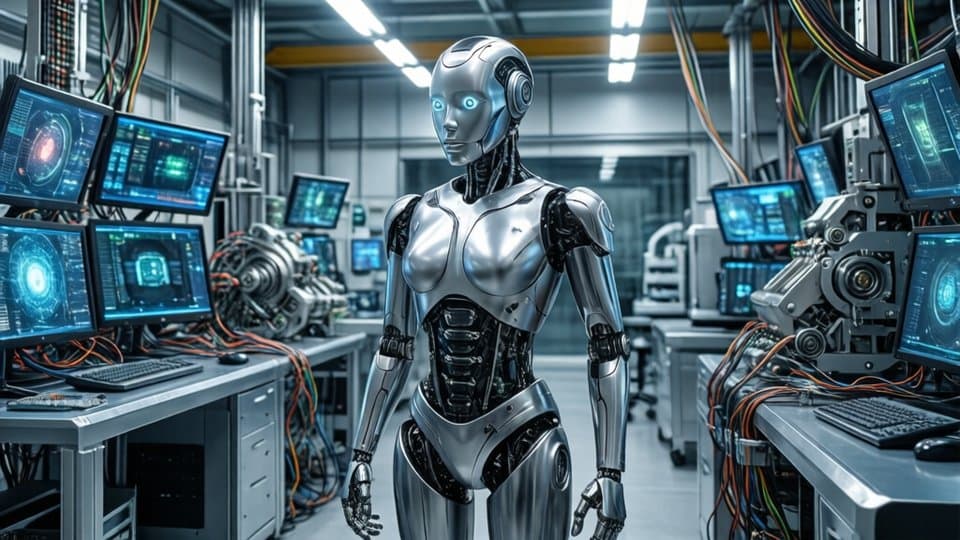
Hangzhou-based Unitree Robotics released a promotional video on Wednesday, October 22, 2026, showcasing the H2-X, a chinese humanoid robot designed for security and rescue. The machine, named "Kung Fu Legend: Guardian," performs martial arts, disarms attackers with knives, and lifts vehicles to save trapped individuals. This development signals a push by Chinese firms to move from entertainment-focused machines toward functional, high-stakes security tools.

What can the H2-X robot actually do?

The H2-X performs complex physical tasks including disarming intruders, smashing car doors, and rescuing pedestrians from oncoming traffic. It demonstrates extreme strength by lifting a car to free a person stuck underneath. The machine also uses martial arts moves to defend people from armed threats.

According to geo.tv, the footage shows the robot confronting an armed intruder and performing acrobatic movements. The video highlights the machine's ability to act in emergency scenarios, such as pulling a pedestrian out of the path of an approaching car. These displays aim to prove the robot can handle both combat and heavy lifting tasks.

The robot's endurance is a key feature of its design. According to e.vnexpress.net, the manufacturer claims a maximum endurance of approximately eight hours. However, the company has not clarified if this time refers to continuous active movement or simply standing still.

How does the H2-X compare to previous models?

The H2-X is an advanced evolution of the earlier H2 model, maintaining similar physical dimensions while offering enhanced capabilities. It retains the core structure of its predecessor but focuses on more aggressive and protective functions. This evolution shows the rapid technical progression within the company.

The technical specifications for the base H2 model provide context for the new machine's power. According to the South China Morning Post, the H2 stands 1.8 metres tall and weighs roughly 70 kilogrammes. The original H2 features 31 degrees of freedom for joint movement and a maximum leg-joint torque of 360 newton-meters.

Unitree Robotics is currently the world's largest humanoid robot manufacturer by sales. By building on the H2 architecture, the company is attempting to transition its hardware from performing dances and somersaults to performing life-saving rescue operations. This shift targets industrial and security sectors rather than just consumer entertainment.

Is the robot's performance autonomous or scripted?

It is currently unknown if the H2-X acts independently or follows a set program. The manufacturer has not confirmed if the security maneuvers were autonomous, preprogrammed, or controlled by a remote operator. This lack of clarity leaves questions about real-world reliability.

There is a significant gap between the promotional footage and real-world application. According to e.vnexpress.net, Unitree has not established whether the robot can independently identify threats and respond safely in unpredictable environments. Without this confirmation, the ability of the machine to distinguish a genuine threat from a harmless situation remains unproven.

The company has previously worked on AI to bridge this gap. In September, Unitree introduced the UnifoLM-X2-1.0 AI model. This system was designed to allow robots to practice combat movements like punching, blocking, and dodging autonomously. The company is also developing further AI to help these machines improve through continued learning.

Who is the leader behind this technology?

Unitree Robotics is led by founder Wang Xingxing, who believes humanoid technology is approaching a massive breakthrough. He views the rapid advancement of artificial intelligence as the primary driver for the next generation of robotic capability. His vision focuses on moving robots into homes and factories.

Wang Xingxing recently shared his outlook on the industry at the China International Industry Fair in Shanghai. According to China Daily, he made the following prediction:

"humanoid robots could reach a 'ChatGPT moment' within one or two years"

Wang Xingxing noted that while the company is already testing robots in automobile factories and residential homes, they still face hurdles. He identified limited efficiency and adaptability as the main barriers preventing widespread adoption of these machines today.

What happens next for Unitree and the H2-X?

The company has not yet set a release date or announced a price for the H2-X. For now, the focus remains on testing and refining the AI that powers the robot's movements. The industry is watching to see if these machines can move from videos to actual work.

While the H2-X is being showcased, the company is also managing safety concerns. Unitree has issued warnings against making dangerous modifications to their machines. They have advised all users to maintain a safety distance of at least two to three metres from the robot during operation.

The broader robotics industry in China is under pressure to prove these machines have practical uses. The success of the H2-X will likely depend on whether the company can prove the robot can handle the chaos of a real-world emergency without human intervention. If the predicted "ChatGPT moment" for robotics occurs within the next 24 months, the H2-X could be part of a much larger wave of autonomous machines.

Frequently Asked Questions

Can the H2-X robot fight humans?
The promotional video shows the robot disarming an intruder with a knife and performing martial arts moves. However, it is not yet clear if these actions are autonomous or preprogrammed.

How heavy is the Unitree H2-X?
The robot is based on the H2 model, which weighs approximately 70 kilogrammes and stands 1.8 metres tall. The specific weight for the H2-X has not been officially disclosed.

When can I buy this robot?
Unitree has not announced a release date or a price for the H2-X. The robot is currently being showcased through promotional demonstrations.

Sources

  1. 1.geo.tvChina unveils 'kung fu' robot bodyguard that can fight attackers, lift cars
  2. 2.e.vnexpress.netWorld's largest humanoid robot maker unveils robot bodyguard that can fight attackers, lift cars

Read more →

Related Articles

Northern Rare Earth Profits Surge as Demand for Rare Earth Permanent Magnet Grows
Chips & Rare Earths

Northern Rare Earth Profits Surge as Demand for Rare Earth Permanent Magnet Grows

China's Northern Rare Earth (600111.SS) reported a massive surge in earnings for the first three quarters of 2026, fueled by rising demand in the new energy and high-end equipment sectors. The company saw its net profit attributable to shareholders jump by 136.55% compared to the same period last year, highlighting the critical role of the rare earth permanent magnet in the global transition to green technology. This financial performance, released on October 23, 2026, underscores the company's dominance in a market currently shaped by supply constraints and shifting industrial needs. How much did Northern Rare Earth earn in 2026? The company achieved significant growth across all primary financial metrics during the first nine months of the year. According to finance.biggo.com , the reported figures for the period from January through September 2026 are: Revenue: CNY 41.333 billion (approximately $6.2 billion), an increase of 36.45% year on year. Net profit attributable to shareholders: CNY 3.646 billion (approximately $546.6 million), up 136.55%. Net profit excluding non-recurring gains and losses: CNY 3.656 billion (approximately $548.1 million), up 168.34%. Total profit for the first three quarters: CNY 5.192 billion (approximately $778.4 million), up 101.07%. The third quarter alone showed even more aggressive momentum. According to finance.biggo.com , third-quarter revenue reached CNY 15.534 billion, representing a 35.96% increase year on year. During these three months, net profit attributable to shareholders rose to CNY 1.593 billion, which is a 161.13% increase year on year and more than 40% higher than the second quarter of 2026. What drove this sudden increase in profits? The profit surge resulted from a combination of limited raw material availability and a sudden release of demand from high-tech industries. According to cj.sina.com.cn , the company benefited from market constraints on the supply side alongside increased demand from the new energy and high-end equipment sectors. These factors caused the prices of major rare earth products to fluctuate at high levels throughout the reporting period. Operational improvements also played a role in the bottom line. The company utilized its full industrial chain to increase efficiency and manage costs more effectively. Higher selling prices and increased sales volumes for major products helped expand gross margins. Production of rare earth smelting, separation, metals, and magnetic materials all reached record highs for this comparable period. The company is also focusing on high-value products to maintain this growth. This includes the development of customized items like low-chloride cerium carbonate and small-particle lanthanum oxide. According to finance.biggo.com , the average prices and sales volumes for lanthanum-cerium products rose year on year, while the total processing cost for these products fell. Who is Northern Rare Earth and why do they matter? Northern Rare Earth is a major Chinese listed company that operates an integrated industrial structure. According to cj.sina.com.cn , the group has developed into a specialized entity that combines rare earth smelting and separation, functional materials, application products, scientific research, and trade. This allows the company to control the process from raw resource extraction to the final industrial application. The company manages several key industrial chains, including: Rare earth permanent magnet materials to permanent magnet motors. Rare earth hydrogen storage materials to solid-state hydrogen storage. Rare earth alloys to rare earth iron and aluminum-magnesium intermediate alloys. The company's reach extends into six major industrial sectors: magnetic materials, polishing materials, energy storage materials, catalytic additives, high-purity metals and alloys, and optical functional materials. This wide footprint makes the company a central player in the global supply of materials used in everything from electronics to renewable energy infrastructure. How is the company expanding its production? Significant capital is being directed toward upgrading facilities and expanding capacity. The company has successfully put Phase I of its green smelting upgrade and renovation project into operation, with the entire production line now running. According to cj.sina.com.cn , Phase II of this project is currently proceeding in an orderly manner, with the construction of the main process plant buildings largely complete and equipment installation underway. Other expansion efforts include: Completion and operation of a secondary resource utilization capacity expansion project. Joint ventures with Ningbo Funeng Rare Earth New Material Co., Ltd. and Ningbo Shuoteng New Material Co., Ltd. to build rare earth metal alloy and magnetic material production lines. Application of 18 national-level and 28 provincial-level research projects. Filing of 107 patent applications. The company is also looking toward the future of technology. According to cj.sina.com.cn , the company intends to expand the use of new rare earth materials in the fields of embodied intelligence and the "low-altitude economy." What are the financial risks involved? Despite the profit growth, the company faces challenges regarding inventory and market volatility. According to finance.biggo.com , the inventory balance at the end of September was CNY 16.874 billion, which is a 5.82% decrease from the end of June 2026. However, the absolute level of inventory remains high, and the company has previously had to make significant write-down provisions, including CNY 731 million in the first half of 2026. The company has issued a warning about future price stability. According to finance.biggo.com , prices for major rare earth products could drop due to several factors: Macroeconomic shifts. Changes in industry cycles. Fluctuations in supply and demand. Geopolitical disruptions. Working capital shifts also merit observation. Notes payable rose to CNY 1.475 billion at the end of September, up from CNY 1.002 billion at the end of June. Meanwhile, contract liabilities fell by 52.71% from the end of June to the end of the reporting period. What happens next for the company? The company is shifting its focus toward high-value-added applications and large-scale industrial upgrades. Northern Rare Earth will continue to push the development of its green smelting projects and its secondary resource utilization capacity. The company plans to use the development of the rare earth permanent magnet motor industry as a primary tool to capture new growth opportunities. Looking forward, the company will target high-energy-consumption motor upgrades and explore more specialized application scenarios. This strategy aims to strengthen the company's position within the rare earth value chain while moving beyond traditional mining and metallurgy markets into advanced high-tech sectors. Frequently Asked Questions Why did Northern Rare Earth's profits increase so much? The increase was driven by high demand from the new energy and high-end equipment sectors combined with limited supply of raw materials and higher selling prices. What products does the company specialize in? The company produces a wide range of materials including rare earth metals, magnetic materials, polishing materials, and high-purity alloys used in advanced technology. Is the company's growth guaranteed to continue? No, the company warned that macroeconomic factors, industry cycles, and geopolitical disruptions could cause the prices of rare earth products to fluctuate downward.

Grace Lin·
Manila and Taipei Seek Cooperation Amidst China in the Philippines Tensions
Southeast Asia

Manila and Taipei Seek Cooperation Amidst China in the Philippines Tensions

The Philippines is exploring closer cooperation with Taiwan to protect undersea communications cables and address maritime "gray-zone" activity, according to a Philippine diplomat speaking in Washington on October 21, 2026. This move aims to secure the Bashi Channel, a vital waterway between the two territories, and represents a shift in how china in the philippines relations might influence regional maritime security infrastructure. Why are the Philippines and Taiwan cooperating on cables? The two sides are looking for ways to secure the undersea data lines that carry almost all intercontinental internet traffic. Because these cables run through the Bashi Channel, both nations have a shared interest in preventing disruptions caused by maritime "gray-zone" activities. Felipe F. Carino III, the Philippine deputy chief of mission in Washington, stated that the two sides are considering "practical cooperation, including knowledge-sharing and capacity building." According to Marine Insight , Carino III linked this effort to the fact that 60% to 67% of cyber incidents occur in the region. The geography of the Bashi Channel makes it a critical corridor. The Philippine Domestic Submarine Cable Network, which serves as a main backbone for the country, spans roughly 2,500 kilometers from Quezon to Zamboanga, according to Astig.ph . What are the specific security threats? The primary concern involves "gray-zone" activities, which refer to actions that apply pressure without escalating to direct military conflict. These activities include the potential for vessels to interfere with or damage the physical cables resting on the ocean floor. Recent incidents have heightened these fears. According to Taipei Times , Taiwan has faced several incidents involving cables and vessels linked to China. Specifically, Andrea Yang, Taiwan’s deputy representative in the United States, noted that a Chinese ship captain was jailed in Taiwan due to damage caused to an undersea cable. The Philippine Coast Guard has also taken action. Earlier this month, the agency deployed its largest vessel and an aircraft to challenge a Chinese research ship, identified as the Jia Hai Ke 7 , operating off northern Batanes province near undersea cable corridors. According to Astig.ph , the coast guard suspected the ship may have been surveying subsea cables while spoofing its location signal. How each side tells it The dialogue surrounding this cooperation reveals a sharp divide between the diplomatic approach of Manila and Taipei and the warnings from Beijing. The Philippines and Taiwan position: Manila describes the cooperation as a "pragmatic and practical approach" to protect mutual interests. Carino III emphasized that these discussions are happening "notwithstanding our one China policy." Taiwan is looking to increase maritime surveillance through technology, with Andrea Yang stating that Taipei will put more resources into developing uncrewed systems to monitor the seas. The Chinese position: Beijing views these interactions as a violation of established diplomatic principles. According to Global Times , Chinese Foreign Ministry spokesperson Mao Ning stated on October 22 that "there is no gray zone on the Taiwan question" and urged the Philippines to adhere to the one-China principle through concrete actions. What is the history of these maritime tensions? The tension in the region stems from overlapping territorial claims in the South China Sea and the status of Taiwan. China claims Taiwan as its own territory and maintains overlapping maritime claims that affect both the Philippines and Taiwan. The One-China Policy: The Philippines officially recognizes Beijing rather than Taipei, a policy that Manila insists remains intact during these new security discussions. Maritime Incidents: Taiwan's Ministry of Digital Affairs reported that its coastal waters saw an average of seven to eight cable incidents per year over the last four years, according to Astig.ph . Recent Escalation: The deployment of Philippine Coast Guard assets to Batanes this month marks a direct response to Chinese research vessels operating near sensitive infrastructure. Who is affected by these cable disruptions? The disruption of these cables would impact international data flows and regional digital stability. Because undersea cables carry nearly all intercontinental data, any damage in the Bashi Channel could isolate parts of the Philippines and Taiwan from the global internet. The economic and security implications are high. Taiwan is actively seeking international support, with Andrea Yang suggesting that interference with undersea cables should be addressed by the United Nations to prevent "bad behavior." For the Philippines, the focus is on protecting the infrastructure that supports its domestic and international communications. What happens next? While no formal treaty has been signed, the cooperation between Manila and Taipei is expected to continue evolving. Carino III indicated that certain measures, such as joint patrols or increased accountability for vessels, "may be actually coming to fruition." The international community will likely watch for further moves from the United Nations regarding cable protection. Additionally, the Philippine government will continue to monitor maritime activity in the Batanes region, particularly concerning research vessels operating near the Bashi Channel. FAQ Why are undersea cables important to the Philippines? Undersea cables carry almost all of the country's intercontinental data flows and internet traffic, making them vital for national communication and the economy. Does this cooperation violate the Philippines' relationship with China? The Philippine government maintains that this is a practical, non-political approach to infrastructure security that exists "notwithstanding" its official one-China policy. What is "gray-zone" activity in the South China Sea? Gray-zone activity refers to actions, such as using research ships to survey sensitive areas, that exert pressure on a country without triggering a full-scale military conflict.

Sara Lindqvist·
Energy Security Shifts as Indonesia Protests Export Norms by Cutting Gas to Singapore
Southeast Asia

Energy Security Shifts as Indonesia Protests Export Norms by Cutting Gas to Singapore

Indonesia began reducing its natural gas exports to Singapore on October 24, 2024, to prioritize domestic energy security and industrial needs. This move involves cutting supplies from both the Natuna and Sumatra regions to ensure reliable gas for Indonesia's own electricity generation and petrochemical sectors. The decision marks a shift in regional energy dynamics as Jakarta seeks to strengthen its domestic downstream capabilities. How much gas is being cut and from where? The total reduction in gas supplies amounts to 31 billion British thermal units per day (BBTUD) . This reduction is split between two major Indonesian production areas to serve local demand instead of foreign markets. According to Straits Times , the specific breakdown of the cuts is as follows: 15 BBTUD from the Natuna gas fields. 16 BBTUD from the Sumatra region, specifically the Jambi Merang gas field. The head of Indonesia's upstream oil and gas regulator, SKK Migas, Djoko Siswanto, confirmed these figures. He stated that the cuts would only impact Singapore because the existing pipeline infrastructure connects those specific fields directly to the city-state. The gas diverted from Natuna will now support state electricity company PLN operations in Batam, while Sumatra's supplies will be redirected to Batam, Bintan, and other parts of Sumatra, according to Straits Times . Will this cause an energy crisis in Singapore? No immediate energy crisis is expected in Singapore because the reduction represents a very small fraction of the nation's total daily requirements. Singapore maintains significant reserves and diverse import sources to manage such fluctuations. A spokesperson for Singapore’s Energy Market Authority (EMA) noted that the reduction is less than 2% of the Republic’s total daily gas demand, which exceeds 1,000 BBTUD . Minister for Energy, Trade and Industry Tan See Leng stated on October 25 that Singapore has sufficient replacement gas from other sources, including liquefied natural gas (LNG). To maintain stability, Singapore utilizes several layers of defense: Diversification of natural gas sources from around the world. Maintenance of standby LNG facilities. Readiness of Singapore GasCo to import more LNG as required. Use of alternative fuels like diesel for power generation. While the supply volume is low, Victor Nian, co-founder of the Centre for Strategic Energy and Resources, suggested that losing pipeline supply might trigger higher energy costs rather than a physical shortage, as noted by Mashable Indonesia . How does each side explain the decision? The two governments hold different perspectives on the necessity and the contractual implications of these supply changes. Indonesia views the move as a matter of national sovereignty, while Singapore emphasizes the importance of honoring commercial agreements. The Indonesian Government Position: Jakarta is prioritizing its own industrial growth and energy independence. Energy and Mineral Resources Minister Bahlil Lahadalia has signaled that the government may not renew export contracts with neighboring countries if domestic needs are not met. He also suggested that Indonesia might review agreements with nations that do not show mutual respect. "I am also perhaps thinking of not extending gas exports to neighbouring countries because we have to survive and meet domestic needs," According to Jakarta Globe , the ministry is reviewing allocations to support the expanding petrochemical sector, which uses gas as a key feedstock for plastics and fertilizers. The Singaporean Government Position: Singapore expects its commercial rights to be protected through existing legal frameworks. Prime Minister Lawrence Wong has stated that the government expects all parties to honor their commitments. "We expect all parties to honour their commitments, and Singapore's gas importer will take the necessary steps to protect its rights and interests under these contracts," The Singaporean leadership maintains that while they understand Indonesia's domestic bottlenecks, the legal integrity of gas supply contracts remains a priority, as reported by AsiaOne . What is the background of Indonesia's gas policy? Indonesia has transitioned from being a major regional exporter to a nation focused on domestic downstream processing. This shift is driven by rising local demand and the government's desire to add value to its natural resources. Key historical and policy points include: Late 1990s/Early 2000s: Pipeline arrangements were established to deliver gas from the Natuna Sea and Sumatra to Singapore. 2022: Jakarta agreed to extend gas supplies to Singapore until 2028, though at lower volumes than previous contracts. Current Allocation: According to Jakarta Globe , Indonesia currently allocates approximately 70% of its natural gas production for domestic use and 30% for export. The current administration under President Prabowo Subianto is pushing to use more gas for high-value manufacturing, such as chemical inputs for the pharmaceutical industry, rather than simply exporting raw fuel. Who is most affected by these gas cuts? The primary impact is felt by Singapore's energy importers and industrial users, though the direct effect on households is expected to be minimal. In Indonesia, the primary beneficiaries are domestic industrial sectors and regional power grids. In Singapore, the natural gas importers, such as Gas Supply Private Limited (GSPL), are the entities dealing with the immediate supply disruption. These importers are expected to pursue commercial remedies if contracts are breached. In Indonesia, the redirection of gas specifically benefits the Batam and Bintan regions, where electricity needs are being met by the diverted Natuna and Sumatra supplies. What happens next? The situation remains fluid as both nations monitor the impact of the supply reduction. Several factors will determine the long-term stability of the energy relationship. Contractual Reviews: Singaporean importers will engage with Indonesian suppliers to determine if any commercial breaches have occurred. Monitoring: SKK Migas has committed to monitoring the new gas distribution arrangements on a daily basis. Policy Evolution: The Indonesian government continues its review of gas export allocations to further boost the domestic petrochemical sector. Long-term Planning: Singapore continues to study alternative energy sources, including the potential use of nuclear energy, to secure its future energy needs. Frequently Asked Questions Will electricity prices rise in Singapore due to the gas cut? Minister Tan See Leng stated that prices are unlikely to be affected in the short term because the cut is less than 2% of total demand and global market prices are a larger factor. Why is Indonesia cutting gas exports now? Indonesia is redirecting gas to ensure energy security for its own domestic electricity generation and to support the growth of its local petrochemical industry. How is Singapore replacing the missing gas? Singapore is using replacement gas from other sources, primarily through the import of liquefied natural gas (LNG) and the use of its diversified global supply chain.

Sara Lindqvist·