
Swiss Researchers Create Walking Hand That Recovers When a Russian Humanoid Robot Falls
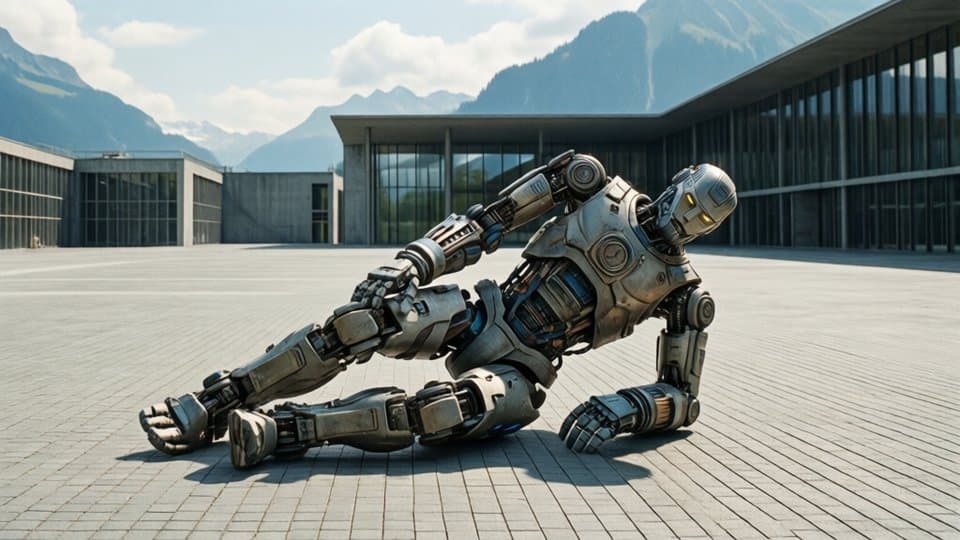
Researchers in Switzerland have demonstrated a mobile robotic hand that uses its five fingers as legs to move independently. This technology, which allows a robotic hand that walks to navigate various surfaces and perform tasks, could eventually allow larger robots to send detached limbs into cramped spaces. The study was published in September 2026 by researchers at the ETH Zurich Soft Robotics Lab.
- The complete robotic setup weighs approximately 818 grams according to Sunday Guardian Live.
- The hand successfully recovered its upright position in 21 out of 25 fall tests, as reported by Hackaday.
- The device achieved a typing accuracy of 29 out of 32 keys, according to PopSci.
How did scientists turn a hand into a walking machine?
Engineers transformed a standard commercial robotic hand into a mobile unit by adding essential hardware to its base. Instead of using a traditional body, the team attached a battery, a small onboard computer, and motion sensors to the area where a wrist would typically connect. This allows the machine to function without being tethered to a robotic arm or a larger power source.
The researchers used a WUJI robotic hand, which is a commercially available model manufactured by a Chinese technology company. According to Hackaday, the team specifically equipped the hand with a Raspberry Pi Zero 2 W to provide the necessary computing power. This setup enables the hand to carry its own weight while moving.
The resulting machine weighs about 1.8 pounds, a figure noted by PopSci. This weight includes all the additional electronics required for autonomous movement. By integrating these components, the researchers created a mobile manipulator that does not require any dedicated locomotion hardware like wheels or legs.
Why is walking with fingers so difficult?
Walking with a human-like hand is harder than walking with a standard four-legged robot because of the hand's uneven shape. Most walking robots use legs of equal length, but a robotic hand has fingers of different lengths and a thumb positioned away from the other digits. This asymmetry makes it very hard to distribute weight and maintain balance.
Every time a finger lifts to take a step, the remaining fingers must support the entire weight of the machine. This becomes even more complex when the hand tries to interact with objects. The researchers had to write specific software to account for this unequal geometry so the hand would not tip over during movement.
To solve this, the team used reinforcement learning, which is a type of artificial intelligence training. They first trained the hand in a computer simulation. This allowed the system to practice moving its 20 joints repeatedly until it learned how to balance itself through trial and error before it ever touched a real floor.
What tasks can the robotic hand perform?
The hand can do much more than just crawl across a floor. Once it reaches a destination, it can use its fingers to manipulate the environment. For example, the hand can push objects toward specific targets. Using overhead visual feedback, the machine moved a small block with an average error of only 17 millimetres, according to Sunday Guardian Live.
The machine is also a surprisingly capable typist. It can balance on several fingers while using a single finger to press keys on a computer keyboard. PopSci reports that the hand successfully hit the correct keys 29 out of 32 times. It can even play simple video games, such as the puzzle game Sokoban, by pressing arrow keys in the correct order.
The hand can also navigate a wide variety of environments. It successfully crossed 14 different surfaces, including grass, gravel, hardwood, stone, carpet, tiles, asphalt, and metal grating. This proves the machine is not limited to smooth, laboratory floors and can operate in more rugged, real-world settings.
Can the robot recover if it falls?
One of the most impressive features of this technology is its ability to right itself. If the hand is knocked over or loses its balance, it does not remain stuck on the ground. During physical testing, the device managed to return to an upright position in 21 out of 25 attempts, as noted by Hackaday. It can typically complete this recovery within twenty seconds.
This ability to recover is vital for any autonomous machine. If a robot cannot get back up, it becomes useless the moment it encounters a bump or a slip. By mastering fall recovery, the researchers have ensured that the hand can continue its mission even after a mistake or an accident in the field.
How could this technology be used in the future?
The researchers believe this mobility will make larger robots much more versatile. Instead of a large robot arm struggling to reach into a narrow gap, the hand could simply detach and crawl inside. This would allow the hand to inspect tight spaces, move items, or operate controls in areas where a full-sized machine cannot fit.
This concept could solve practical problems in many industries. It could prevent tools from being lost in hard-to-reach places or allow for more delicate inspections in manufacturing. As companies like Tesla and Figure continue to develop humanoid robots, adding independent mobility to limbs could be a major step forward.
What is the current status of this research?
The findings were presented in a recent preprint, meaning the research paper has not yet undergone formal peer review or been officially accepted for publication in a scientific journal. While the results are promising, the technology is still in the experimental stage. The researchers noted that the hand still has some limitations, such as drifting to the right while walking, which requires constant software correction.
Future work will likely focus on improving the hand's steering and its ability to navigate even more complex environments. There is also potential to improve how the hand handles objects, which would make it even more useful for tasks in homes or factories. For now, the project serves as a successful proof of concept for independent limb mobility.
What happens next: The research is currently awaiting peer review for formal scientific publication. No specific dates for commercial release have been announced.
FAQ
Can the robotic hand move without an arm attached?
Yes, the hand is equipped with its own battery, computer, and sensors, allowing it to move independently of a larger robot.What surfaces can the robot walk on?
The hand has been tested on 14 different surfaces, including grass, gravel, carpet, and metal grating.Is this a real product you can buy?
No, this is currently a research project developed by scientists at ETH Zurich to explore new ways for robots to move.SEO Meta Description: Discover how Swiss researchers created a walking robotic hand that uses its fingers as legs to navigate terrain and perform tasks like typing and gaming.
URL Slug: robotic-hand-walks-on-fingers-eth-zurich
Sources
- 1.sundayguardianlive.comWATCH VIDEO: Robotic Hand That Walks Like a Human? Scientists Create Robotic Hand That Walks on Fingers, Plays Games and Picks Itself Up After Falling
- 2.hackaday.comTeaching A Robot Hand To Walk
- 3.popsci.comSevered robot hand looks like a futuristic Thing from ‘The Addams Family’