

Newzix
Breaking News
South Asia

Nepal Demands Climate Reparations After Deadly Floods Cause $5 Billion in Damage
Arjun Mehta4 min read
Nepal Demands Climate Reparations After Deadly Floods Cause $5 Billion in Damage

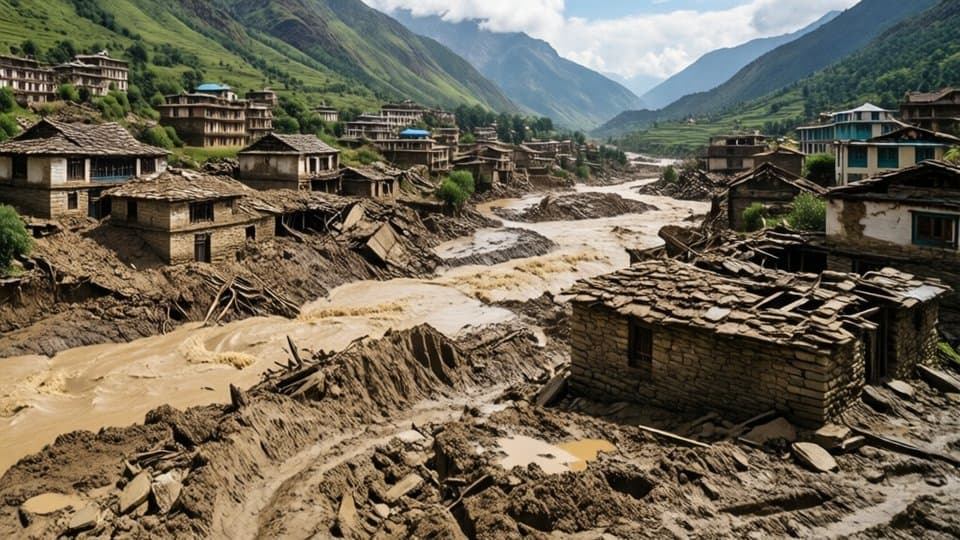
Nepal is demanding international climate justice and financial compensation following catastrophic floods and landslides that killed over 1,400 people in August. The government argues that the nation faces an existential crisis caused by greenhouse gas emissions it did not produce, seeking urgent access to global relief funds.

  • The August 26 floods killed at least 1,367 people, according to UN News.
  • More than 5,000 people remain missing following the disasters, per People's Review.
  • Nepal contributes less than 0.1% of global heat-trapping gases, according to NBC News.

What caused the massive flooding in Nepal?

A melting glacier triggered the initial disaster on August 26, which devastated the northern regions of Rasuwa, Nuwakot, and Dhading. International scientists have linked the instability of the glacier to melting permafrost caused by the burning of coal, oil, and gas. This collapse resulted in massive waves and debris-laden floods that swept through mountain communities.

The destruction was widespread. The UN reported that the floods washed away entire settlements and shifted riverbanks. Beyond the initial August event, subsequent disasters like the October 11 debris-laden flood in Gorkha's Budhigandaki have continued to impact the country. These events have damaged critical roads, schools, power grids, and water systems.

How much damage did the floods cause?

The economic impact of the climate disasters is a massive burden on the national budget. Nepal's Foreign Minister, Shisir Khanal, stated at the UN that the country has suffered losses exceeding $5 billion from the recent disaster alone. This figure represents nearly 15% of the national GDP and one-third of the annual budget, according to NBC News.

The human toll is equally severe. While UN News confirmed 1,367 deaths, People's Review reported that the Bhotekoshi disaster specifically killed more than 1,450 people. The scale of the tragedy has left thousands of families searching for relatives carried away by waves reaching 20 meters in height.

How does Nepal view the global response?

Nepal's leadership argues that the current international financial system is too slow and complicated for countries in immediate crisis. Prime Minister Balendra Shah criticized the existing aid structures during his address to the UN General Assembly. He emphasized that the victims should not have to navigate complex systems while their homes are being destroyed.

"Climate finance must not become another bureaucratic maze through which vulnerable countries spend years maneuvering when they need help. When the house is burning, we do not ask a family to complete 50 forms. We act. This is what climate justice means."

Shah, the youngest head of government to address the General Assembly this year, called for a shift toward responsibility and reparation. He noted that glaciers and floods do not recognize international borders. The Prime Minister argued that political leaders have been negligent in turning scientific warnings into meaningful action.

How each side tells it

The Nepalese government views the disaster as a direct consequence of the actions of industrialized nations. Foreign Minister Shisir Khanal described the situation as a justice crisis that exposes global inequities. The government is pushing for "reparation," a term that addresses the historical responsibility of high-emitting nations.

In contrast, the response from major emitters like the United States focuses on traditional humanitarian aid rather than legal reparations. While the U.S. has provided $36 million in total aid to Nepal for flood recovery, NBC News notes this is less than 1% of what is required. The tension remains between providing charity and acknowledging the legal obligation of reparation.

What are the immediate needs for survivors?

The UN and the Government of Nepal have launched a flash appeal for $49.6 million to support 84,000 people. This funding is intended to provide shelter, healthcare, and cash support before the end of December. However, as of the latest UN update, only $22 million has been received.

Rescue and relief operations are ongoing but face significant logistical hurdles. UN Resident Coordinator Lila Pieters Yahia noted that reaching the most vulnerable areas remains a challenge. To combat this, the World Food Programme used cargo drones to deliver food to communities that were completely cut off by the rising waters. Urgent priorities include restoring water systems and providing mental healthcare to those traumatized by the loss of loved ones.

What happens next?

Nepal is currently participating in the COP31 conference in Antalya, Türkiye, to secure international support. Several key diplomatic actions are scheduled for the coming days:

  • On November 12, Nepal will host a high-level mountain agenda meeting with Tajikistan, Kyrgyzstan, Bhutan, and Pakistan.
  • Nepal and South Korea are scheduled to sign a bilateral memorandum of understanding regarding carbon trading.
  • Minister Geeta Chaudhary is set to lead technical discussions at the conference to demand easier access to the Loss and Damage Fund.

Frequently Asked Questions

What is the Loss and Damage Fund?
It is a fund established in 2022 to provide financial assistance to developing nations that are disproportionately affected by climate change effects they did not cause.

Why is Nepal specifically vulnerable to climate change?
The country's geography makes it susceptible to melting glaciers and unstable mountain slopes, which trigger deadly floods and landslides.

How much aid has the United States provided to Nepal?
The United States has provided a total of $36 million in financial help for flood recovery, according to NBC News.

Sources

  1. 1.un.orgFlood-ravaged Nepal calls for climate justice
  2. 2.nbcnews.comNepal’s leader, at U.N., says recent floods serve as a ‘warning to the world’ about climate change
  3. 3.peoplesreview.com.npCOP31: Nepal seeks justice for climate-related disasters

Read more →

Related Articles

Analyzing China Underwater Drone Capabilities and New Mothership Designs
Drones & Defense Tech

Analyzing China Underwater Drone Capabilities and New Mothership Designs

Beijing is rapidly advancing its maritime technology, leading to a global shift in how nations approach china underwater drone capabilities as of late 2026. The development of massive support vessels and autonomous systems is moving the competition away from individual ships toward the ability to deploy, maintain, and recover large fleets of unmanned assets in distant waters. Is China building a massive drone mothership? Satellite imagery and vessel designs suggest China is constructing a specialized ship to deploy and manage large fleets of uncrewed underwater vessels (UUVs). This vessel would act as a mobile base, allowing autonomous systems to operate far from home ports without constant human intervention. In early September 2026, images appeared online showing a vessel under construction in a 1,115-foot-class dry dock, according to Slashgear . The ship measures roughly 656 feet long with a 98-foot-wide beam. Observers noted a multi-layer deck structure with ramps similar to car carriers and a large hangar that could potentially house four Extra-Large Uncrewed Underwater Vehicles (XLUUVs). These XLUUVs are a growing category of underwater drones, typically measuring between 20 and 82 feet in length. China reportedly unveiled two operational XLUUVs at the 2025 Victory Parade, measuring between 59 and 66 feet long, and has allegedly been testing models twice that length, Slashgear reports. How do China's underwater systems compare to the West? While China focuses on large-scale deployment via motherships, the United States and Australia are pursuing different technological paths. The competition is split between China's industrial capacity for massive autonomous fleets and the West's focus on specialized mission capabilities and integrated alliances. The United States has demonstrated high-end specialized capabilities. According to 24Ore NextMed , the Orca vehicle completed a voyage of over 1,000 nautical miles in July 2026. Additionally, the Yellow Moray system was deployed on three missions off the coast of Norway in 2025, launched from the torpedo tubes of the USS Delaware without needing divers. Australia is investing heavily in its own autonomous systems through the Ghost Shark program. This contract, worth 1.7 billion Australian dollars, was announced in September 2025 and covers production, maintenance, and development over five years, according to 24Ore NextMed . While the Ghost Shark is a major asset, its technology involves a mix of American and Australian components, with the design originating from the U.S. company Anduril. What is the strategic value of these drones? Underwater drones provide a way to conduct surveillance, lay mines, or carry out attacks while minimizing risk to human crews. They allow nations to project power into contested areas and protect vital undersea infrastructure like digital cables and energy pipelines. China's advantage may lie in its ability to support these drones long-term. According to 24Ore NextMed , China has extensive experience in oceanographic research and deep-sea operations. The Guangzhou Shipyard International built the research vessel Tansuo San Hao, and much of the Chinese research fleet is already equipped with specialized laboratories and seabed exploration equipment. The shift in naval warfare is about more than just the drones themselves. Future maritime power depends on the ability to manage sensors, mission payloads, software, and recovery infrastructure. The goal is to create a closed loop where drones can be deployed, used, recovered, and serviced close to an enemy coastline. How do different nations approach the technology? The global landscape is filled with various specialized projects. While China builds large-scale mothership concepts, other nations are developing specific unmanned platforms for different tactical roles. According to Sohu , the current global lineup includes: The United States: Razorback and solutions from Boeing and Lockheed Martin. The United Kingdom: The Whale. France: The Ocean Explorer from Naval Group. Russia: The nuclear-powered Poseidon. Australia: The Ghost Shark. China's domestic development is led by institutions like the Shenyang Institute of Automation and Harbin Engineering University. These groups have produced the Qianlong series of AUVs and the Haidou seabed exploration vehicles. The HSU001, shown during a 2019 parade, is widely considered a reconnaissance-style XLUUV, Sohu reports. How each side tells it The debate over these developments focuses on whether the advantage lies in the size of the drone or the infrastructure that supports it. Western observers often focus on the technical sophistication of individual units, while analysts look at China's ability to mass-produce and deploy them. Western analysts, as reported by Slashgear , suggest that China's potential mothership could reshape naval warfare by allowing for long-term, forward-deployed operations of large uncrewed fleets. On the other hand, the AUKUS alliance emphasizes shared technology rather than identical hardware. On 19 October 2026, Pat Conroy, the Australian Minister for Defence Industry, stated: "Underwater cooperation within the framework of AUKUS is currently focused on common sensors and payloads, leaving the choice of platforms to individual partners." This approach aims to share essential technologies to reduce costs without forcing all partners to use the same vehicles, according to 24Ore NextMed . What happens next? The race for underwater dominance will be defined by upcoming industrial milestones and technological integration. Nations are moving from the design phase to long-term production and alliance-building. The Ghost Shark program in Australia will continue its five-year production and development cycle following its 2025 launch. AUKUS partners will continue working on integrating common sensors and payloads to reduce design costs. Continued monitoring of Chinese shipyard activity will provide more clarity on the capabilities of the new 656-foot vessel. Frequently Asked Questions What are XLUUVs? Extra-Large Uncrewed Underwater Vehicles are a class of autonomous submarines, typically between 20 and 82 feet long, used for missions like surveillance or mine-laying. Why are motherships important for underwater drones? Motherships allow drones to be transported, launched, and recovered far from home bases, which extends their operational range and allows for continuous maintenance. Is the US falling behind in underwater drone technology? The US is pursuing high-end, specialized systems like the Orca and Yellow Moray, while the AUKUS alliance works to integrate these technologies with partners like Australia.

Marcus Hale·
China Purges Top Military Leaders Over Corruption and Disloyalty
China & Taiwan

China Purges Top Military Leaders Over Corruption and Disloyalty

China expelled two of its highest-ranking military leaders from the Communist Party on September 21, 2026, following investigations into corruption and disloyalty. This move signals a deepening purge within the People's Liberation Army as President Xi Jinping intensifies his long-running anti-corruption campaign. Al Jazeera reported on Monday that General Zhang Youxia and General Liu Zhenli were expelled for violating political discipline. Rediff stated that General Zhang Youxia was the highest-ranking uniformed officer in the Chinese military. According to Al Jazeera , the investigations into both men began in January 2026. Who are the generals being expelled? The expelled officials are General Zhang Youxia, 75, and General Liu Zhenli, 61. Both men held top positions within the Central Military Commission, the supreme command body of the Chinese military headed by President Xi Jinping. General Zhang Youxia served as the first-ranking vice chairman of the seven-member Central Military Commission. This role made him the highest-ranking uniformed officer in the country. He was also a member of the 24-member politburo, which serves as the center of power for the Communist Party. Rediff noted that Zhang was a high-profile figure who had been long seen as a close military ally to Xi Jinping. General Liu Zhenli was a member of the Central Military Commission and served as the chief of staff of the Joint Staff Department. Both generals were notable for their military backgrounds. Rediff reported that Zhang and Liu were decorated war heroes who were the only two members of the Central Military Commission with combat experience, having both participated in People's Liberation Army campaigns against Vietnam in the late 1970s. Why were these officers removed? The officials were removed for serious violations of party discipline, corruption, and political disloyalty. The state-run Xinhua news agency cited official documents stating the generals formed cliques and factions and were dishonest to the party. Specific details regarding the alleged crimes were not provided by official sources. However, Rediff noted that Zhang was formally detained by military corruption investigators in January 2026. He faced accusations of corruption and failing to control the actions of his close associates, family members, and relatives. The South China Morning Post reported that Zhang was also blamed for failing to report problems to the party leadership immediately. These findings led to a meeting of the political bureau of the Communist Party central committee on Monday, which approved the reports regarding the handling of the cases of Zhang and Liu. How does this fit into the broader crackdown? These expulsions are part of a massive anti-corruption campaign led by Xi Jinping that began in 2012. The campaign targets both "tigers and flies," referring to high-ranking and low-ranking officials respectively. The military has become a primary target of these purges. Al Jazeera reported that the military has seen an increasing number of targets, leaving only two active members on the formerly seven-member Central Military Commission, including Xi Jinping himself. This includes the dismissal of the second-highest-ranking general and eight other senior officials from the military and party. Previous high-profile removals include the former Defence Minister, Li Shangfu, and his predecessor, who were both expelled in June 2024. The current wave of removals shows that even the most decorated and senior officers are not immune to the ongoing scrutiny of the central leadership. How do the different reports describe the charges? While both sources agree on the expulsion of the two generals, they emphasize different aspects of the misconduct. The official reasons focus on political discipline and the structure of the military command. Al Jazeera quoted the Xinhua news agency stating that the generals "seriously violated political discipline and political rules, formed cliques and factions, and were disloyal and dishonest to the party." This phrasing highlights a breakdown in the political unity required by the Communist Party. Rediff focused on the legal and disciplinary violations, stating the expulsion was due to "serious discipline and law violations." While the core of the accusations involves corruption, the political dimension of "forming cliques" is a central theme in the official state reporting. What is the background of the anti-graft campaign? President Xi Jinping initiated this extensive anti-graft campaign when he took power in 2012. It has since become one of the largest purges in modern Chinese history. The campaign has resulted in thousands of officials being purged and millions of individuals within the Chinese bureaucracy being investigated. The scale of the investigation is unprecedented. The campaign has moved from general bureaucracy into the upper echelons of the People's Liberation Army, targeting top command structures. The timing of these military removals is notable. Al Jazeera reported that the Defence Ministry announcement came just days before Xi Jinping is scheduled to meet with US President Donald Trump in Washington. It also occurs weeks before a key Communist Party assembly focused on internal governance. What happens next? The immediate aftermath involves the formal removal of Zhang and Liu from all party and military roles. The leadership will likely continue to fill the vacancies left in the Central Military Commission. The upcoming Communist Party assembly on internal governance will be a critical moment for observing how the party handles the resulting leadership vacuum. Additionally, the scheduled meeting between President Xi Jinping and US President Donald Trump in Washington will take place in the coming days. The military must now reorganize its command structure. With only two active members remaining on the seven-member Central Military Commission, the process of appointing new, vetted officials will be a priority for the central government. FAQ Who are the two generals expelled from the Chinese Communist Party? The expelled officials are General Zhang Youxia, the highest-ranking uniformed officer in the military, and General Liu Zhenli, the chief of staff of the Joint Staff Department. What were the reasons for their expulsion? The generals were accused of corruption, violating political discipline, and forming cliques or factions that were disloyal to the party. When did the investigations into these generals begin? Investigations into both General Zhang and General Liu were officially announced in January 2026. SEO Meta Description: China expels top generals Zhang Youxia and Liu Zhenli from the Communist Party amid a deepening anti-corruption purge led by President Xi Jinping. URL Slug: china-expels-generals-zhang-youxia-liu-zhenli-corruption-purge

Elena Marsh·
Thousands Missing After Devastating Glacial Collapse Near Nepal-China Border
South Asia

Thousands Missing After Devastating Glacial Collapse Near Nepal-China Border

A massive glacial collapse near the Nepal-China border on August 26, 2026 , triggered catastrophic flooding that destroyed entire communities and left a heavy toll of death and displacement. The disaster, which sent a wall of water through northern Nepal and Tibet, has prompted international aid efforts and desperate prayers from families of the missing. Crosswalk reports that more than 1,400 bodies have been recovered. The EWN reported that nearly 4,500 people remain missing. The Portsmouth Anglican source states more than 1,500 people lost their lives. What caused the massive flooding in the region? A sudden geological event near the Tibetan border released a torrent of water, mud, and debris that moved with extreme speed. This surge devastated the landscape in a matter of minutes, erasing villages and infrastructure across the Himalayan border region. Survivors described a terrifying wall of water reaching heights of more than 100 metres . According to the Portsmouth Anglican report, this wave traveled at speeds of 180 kilometres per hour . It destroyed 60 kilometres of valley in seconds. The Crosswalk report notes that the debris traveled 14 miles in just 7 minutes . This surge impacted communities in northern Nepal and Tibet before hitting the Chinese port town of Gyirong. The disaster was caused by a massive section of rock and glacier ice giving way. How many people have been affected by the disaster? The scale of human loss is immense, with fatalities rising and thousands of individuals still unaccounted for. The destruction has left families grieving and entire social structures broken by the sudden loss of homes and loved ones. Death toll figures vary slightly between reports. EWN reported on September 3, 2026, that rescue teams recovered more than 1,100 bodies. However, the Portsmouth Anglican source lists the death toll as more than 1,500 people. Thousands remain missing. The physical damage is equally severe. Entire communities, including bridges, schools, and dams, were swept away. According to the Portsmouth Anglican report, the floods hit the Bhote Koshi River in the Rasuwa district and the Trishuli River . This has left children without parents and displaced many families. What is the international response to the crisis? Governments and humanitarian organizations have deployed significant resources to search for survivors and provide relief. The response involves both military personnel and specialized rescue equipment to navigate the difficult terrain. Nepal's government deployed 19,000 security personnel and 16 helicopters for search operations. China contributed 2,100 rescue workers and approximately $32.7 million in aid, according to Crosswalk . The United Nations and the Red Cross are also participating in the efforts. Local religious groups are providing immediate practical aid to those who survived. The Portsmouth Anglican report highlights the Nazarene Church in Kathmandu, which has distributed food to 191 families and provided blankets to 182 families. They also gave roofing sheets to 46 families to help build temporary shelters. How are families of the missing coping? For many families, the uncertainty of whether their loved ones are alive or dead is a source of extreme agony. The lack of information from local authorities makes the waiting period particularly difficult for those far from the disaster zone. One such case involves the Govender family from South Africa. Their daughter, Terricia Govender , a 33 -year-old data analyst, went missing while on a pilgrimage to Mount Kailash . EWN reported that her mother, Linda Govender , was traveling to Nepal to be closer to the search efforts. "My prayers today is for me to bring Terricia back home safely. We are a party of three travelling, and we are hopeful that we will be a party of four coming back. All I can do right now is pray. I am hoping for a miracle that my daughter will come back to me." — Linda Govender , mother of Terricia Govender, as reported by EWN . Who are the key people involved in relief? Local leaders and religious figures are playing a major role in coordinating community support and managing the long-term recovery of affected areas. These individuals often work with limited resources to meet urgent needs. The Portsmouth Anglican report mentions Rev Rinzi Lama , the first Anglican priest to serve in Nepal. He founded the New Creation Home in Kathmandu in 2003 , an orphanage for homeless children. He has experience coordinating relief for previous disasters like earthquakes and monsoons. The Portsmouth Anglican report also features Rev Sam Cullen , who visited Nepal to gather prayer requests. She met with local Christians, Buddhists, and Hindus to understand the impact of the floods on various religious communities during the pilgrimage season. What happens next for the recovery efforts? The focus is shifting from immediate rescue to long-term recovery and the search for the thousands of people still missing. This process will require sustained international attention and significant financial support. Search and recovery operations continue as teams attempt to locate bodies downstream. The Crosswalk report notes that morgues in the region have already run out of refrigeration space for the bodies being recovered. Charitable organizations are calling for continued donations to support displaced families. The Portsmouth Anglican report emphasizes the need for resources to provide shelter, clothing, and food as the community attempts to rebuild what was lost. Frequently Asked Questions What caused the floods in Nepal? A massive section of rock and glacier ice collapsed near the Nepal-China border, creating a high-speed wall of water and debris. How many people are missing? While figures vary, EWN reports that nearly 4,500 people remain missing following the disaster. Is there international aid available? Yes, China, the United Nations, the Red Cross, and various governments including the U.S. and U.K. have provided aid and personnel.

Arjun Mehta·