Newzix
Breaking News
Chips & Rare Earths

Apple debuts iPhone 18 Pro using TSMC 2nm chip technology
Grace Lin6 min read
Apple debuts iPhone 18 Pro using TSMC 2nm chip technology

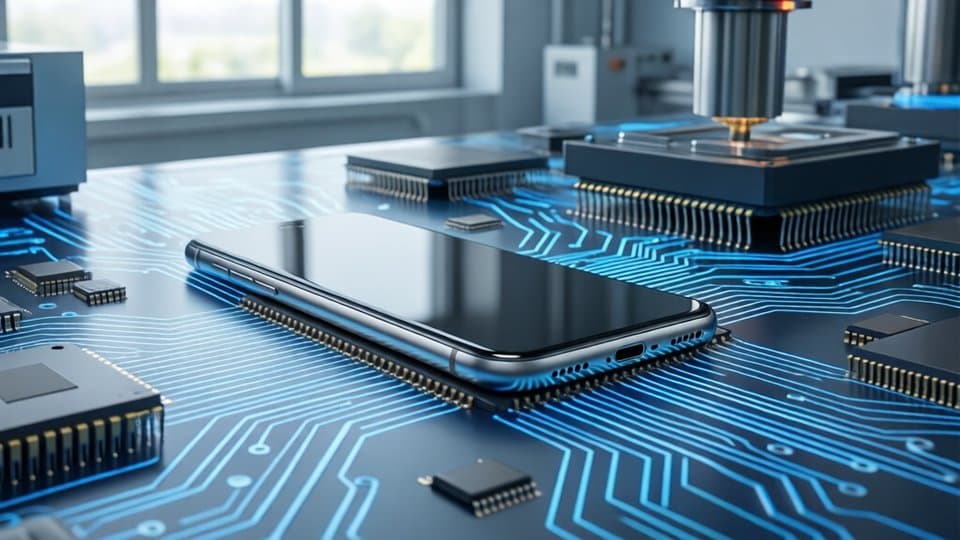
Apple officially unveiled the iPhone 18 Pro at its "Surprise and Shine" keynote on Tuesday, September 9, 2026, featuring the industry's first consumer chip built on TSMC 2nm manufacturing. This transition to a new semiconductor process marks a major shift from the previous FinFET architecture to gate-all-around transistors to improve efficiency. The launch also signals a leadership change at Apple, with hardware engineer John Ternus taking over as CEO from Tim Cook.

  • Apple introduced the A20 Pro chip using TSMC's N2 process on September 9, 2026, according to TechTimes.
  • The new A20 Pro GPU is up to 40 percent faster than the previous A19 Pro model, as reported by TechTimes.
  • The iPhone 18 Pro Max carries a weight of 249g, making it heavier than the Samsung Galaxy S26 Ultra, according to Android Headlines.

What makes the new 2nm transistor architecture different?

The move to the N2 process replaces the FinFET structure that has been the industry standard for over ten years. In the older FinFET design, the gate only surrounded the silicon channel on three sides. The new gate-all-around (GAA) nanosheet technology allows the gate to wrap around all four sides of the channel.

This structural change provides much tighter control over current leakage and drive current. According to TechInsights, this helps reduce power leakage while simultaneously improving performance. For mobile devices, this efficiency is vital to manage battery life and heat within a small frame.

TSMC's specifications indicate that this N2 process can deliver a 15 percent performance boost and a 35 percent reduction in power consumption compared to the 3nm N3E technology. This allows the iPhone 18 Pro to handle heavier tasks without draining the battery as quickly as older models.

How does the A20 Pro improve AI and graphics?

The A20 Pro uses the density benefits of the new process to add more hardware rather than just making the chip smaller. While the compute die measures approximately 98.2 mm², which is nearly the same size as the A19 Pro, it contains more functional components. The chip features a six-core CPU with two performance cores and four efficiency cores.

The device also includes more space dedicated to neural processing. This area contains specialized engines for matrix multiplication and convolution, which are necessary for machine learning. According to TechTimes, the GPU is up to 40 percent faster than its predecessor, which helps with demanding graphics workloads.

Memory bandwidth also plays a critical role in running artificial intelligence. The iPhone 18 Pro ships with 12GB of unified memory and 50 percent higher bandwidth than the A19 Pro. This higher throughput allows large language models to run locally on the device rather than relying on cloud-based processing.

Is the new memory packaging better for heat?

Apple has changed how it connects memory to the processor. In older designs, memory was stacked directly on top of the chip in a package-on-package setup. The A20 Pro uses a wafer-level multi-chip module where the processor and memory sit side by side.

This new side-by-side arrangement is intended to improve heat transfer and allow for a wider memory interface. Preliminary analysis by TechInsights suggests the chip uses a 96-bit LPDDR5X interface. This provides the high bandwidth required for intensive AI and graphics tasks.

To support this, Apple included a new vapor chamber for cooling. This component has three times the surface area of the system found in the iPhone 17 Pro. According to Android Headlines, this helps the phone sustain higher performance levels during intense gaming by preventing the chip from throttling due to heat.

How does the iPhone 18 Pro compare to Samsung?

The competition between the iPhone 18 Pro Max and the Samsung Galaxy S26 Ultra highlights the gap between different manufacturing processes. While the iPhone uses the 2nm A20 Pro, the Samsung flagship uses the Snapdragon 8 Elite Gen 5, which is built on a 3nm process. This gives the Apple device a technical advantage in both speed and efficiency.

Performance benchmarks show the difference in real-world use. In a 3DMark Wildlife Extreme Stress Test, the iPhone 18 Pro achieved a stability score of 68.6%, while the Samsung Galaxy S26 Ultra reached 57%. This indicates that the Apple chip maintains its speed more effectively under heavy load.

However, the two phones differ significantly in weight and features. The Samsung model is lighter at 214g, compared to the 249g iPhone. Additionally, Samsung offers high levels of software customization through One UI, whereas Apple focuses on a more controlled ecosystem. While Samsung promises seven years of updates, Apple typically provides six to eight years of support for its devices.

What are the new camera and display features?

The iPhone 18 Pro introduces a mechanical variable aperture for the first time. Unlike previous models that used a fixed f/1.78 aperture, this new system uses six physical iris blades. This allows the camera to change how much light reaches the sensor by adjusting the opening between f/1.48 and f/4.

This hardware change allows for better control over depth of field and low-light performance. Apple claims the widest setting offers 50 percent better low-light performance than previous generations. This is a major shift from the previous method, which relied almost entirely on software to manage bright light conditions.

The display also features a redesigned Dynamic Island. The new technology creates more usable space within the pill-shaped cutout, allowing it to display three Live Activities at once. Previously, the Island could only show a maximum of two simultaneous activities, such as a music player and navigation.

What is the background of this transition?

The iPhone 18 Pro launch marks a transition in both hardware and leadership. For over a decade, the mobile industry relied on FinFET transistors. The shift to 2nm gate-all-around technology represents the first major change in how mobile processors are built in years.

The company is also undergoing a leadership change. Tim Cook, who led Apple for 15 years, has transitioned to the role of executive chairman. John Ternus, a hardware engineer who has been with the company for 25 years, has taken over as CEO. This change suggests a continued focus on hardware engineering and silicon development.

Pricing for the new models has also increased. The iPhone 18 Pro starts at $1,199, and the iPhone 18 Pro Max starts at $1,299. This represents a $100 increase over the previous generation of Pro iPhones.

What happens next?

Consumers can begin pre-ordering the new iPhone 18 Pro models on Saturday, September 12, 2026. The devices are scheduled to begin shipping to customers on Friday, September 18, 2026. The standard iPhone 18 is not expected to arrive until the spring of 2027.

Frequently Asked Questions

Will the iPhone 18 Pro be much faster than the iPhone 17 Pro?
Yes, the A20 Pro chip's GPU is up to 40 percent faster, and the 2nm process provides better efficiency and sustained performance.

What is the main difference between the A20 Pro and older chips?
The A20 Pro uses gate-all-around nanosheet transistors instead of the older FinFET architecture, allowing for better control over electricity and less heat.

Does the iPhone 18 Pro have a better camera?
The new main camera features a mechanical variable aperture, which provides better low-light performance and more natural control over depth of field.

Sources

  1. 1.techinsights.comApple A20 Pro: Inside the iPhone 18 Pro’s TSMC 2nm Processor
  2. 2.techtimes.comiPhone 18 Pro Unveiled: 2nm A20 Pro Chip, Variable Aperture, Dynamic Island Rebuilt
  3. 3.finchannel.comApple iPhone 18 Pro Review: A Major Upgrade or Another Incremental iPhone?
  4. 4.androidheadlines.comApple iPhone 18 Pro Max vs Samsung Galaxy S26 Ultra: Which 2026 Flagship Is Actually Worth It?
Read more →

Related Articles

ASEAN Leaders Call for Localized Academic Partnerships
Southeast Asia

ASEAN Leaders Call for Localized Academic Partnerships

Education leaders met in Manila on 27-28 October 2026 to demand that international academic partnerships prioritize local economic needs over exported Western models. The discussions focused on ensuring that transnational education and research support regional goals like the blue economy and digital transformation. More than 96,000 students in the ASEAN region are currently involved in UK transnational education programs, according to thepienews.com . The EU-funded SCOPE-HE programme operates with a budget of EUR 9.3 million through January 2028, according to eeas.europa.eu . By 2030 , approximately 39% of current skills will no longer be relevant, according to Michelle Aguilar-Ong of the Philippines' Commission on Higher Education. What are the new priorities for regional education? Regional leaders want education to move away from theoretical models and toward practical skills that support specific local industries. They argue that international cooperation must align with the urgent needs of Southeast Asian economies to be effective. Michelle Aguilar-Ong, a commissioner for the Philippines’ Commission on Higher Education (CHED), stated that her country is preparing a national strategy for transnational higher education. This strategy identifies digital transformation, renewable energy, and the blue economy as the main areas for international cooperation. The goal is to ensure that learning directly supports these sectors. The blue economy is a central focus for both ASEAN and the European Union. Discussions in Manila centered on how higher education and Technical and Vocational Education and Training (TVET) can support fisheries, maritime transport, coastal tourism, and offshore renewable energy. This alignment aims to protect oceans while building stronger communities. How should universities collaborate across borders? Experts suggest that successful partnerships require co-designing programs with local institutions rather than simply transplanting existing foreign curricula. This approach ensures that the education provided is actually valuable to the host country's workforce and economy. Kostantino Kontis, dean for global engagement in China and East Asia at the University of Glasgow, advised that universities should "co-design programs that the partner identifies as valuable". He noted that even small amounts of seed funding can help academics build the foundations for much longer-term partnerships. Sir Steve Smith, the UK’s international education champion, emphasized that transnational partnerships must be mutually beneficial. He argued that successful models should strengthen both the sending and receiving institutions. He also noted that students must receive high-quality teaching, clear information about qualifications, and appropriate support throughout their studies. Why is the UK focusing on Southeast Asia? The United Kingdom views the ASEAN region as a vital long-term partner for research, skills development, and education. British institutions are already deeply embedded in the region through various joint programs and student exchanges. Daley Middleton, head of trade at the UK’s Department for Education, highlighted the massive scale of current engagement. He reported that more than 39,000 students from Southeast Asia studied at UK higher education institutions during the last academic year. This reflects decades of research collaborations and people-to-people connections. Several British universities are already active in the region. These include the University of Reading, University of Leeds, University of Liverpool, Newcastle University, Goldsmiths, and Liverpool Hope. These institutions are working with local partners to develop joint programs that meet regional demands. How do the UK and EU approach these partnerships? While both the UK and the EU seek to deepen ties with ASEAN, they use different frameworks to achieve these goals. The UK emphasizes its extensive experience in transnational education, while the EU utilizes large-scale funding packages to drive connectivity. The European Union manages the SCOPE-HE programme, which is part of the EU’s Global Gateway strategy. This initiative aims to build reliable and inclusive connections through investment in maritime sectors, research, and innovation. The programme runs from February 2024 to January 2028 and is implemented by Nuffic in partnership with the German Academic Exchange Service (DAAD). The UK approach focuses on the quality and experience of its institutions. Daley Middleton noted that while British universities offer "world-class quality," ASEAN nations have many choices. He stated, "As fabulous as we are [in the UK], ASEAN does not necessarily need to choose one partner, and we obviously encourage everyone to advocate for their own needs." How each side tells it The discussions in Manila revealed different perspectives on how international aid and education should be structured to benefit the region. "By 2030, 39% of the skills today won’t be relevant anymore." Michelle Aguilar-Ong, Commissioner of the Philippines’ Commission on Higher Education "Whether the blue economy succeeds will come down to more than growth figures; it will show in whether our oceans hold up, whether communities are stronger, and whether young people have real prospects." Dr Kao Kim Hourn, ASEAN Secretary-General What happens next? The outcomes of the Manila meetings will be formalized into the Manila Policy Brief. This document will provide actionable recommendations for policymakers and stakeholders to improve cooperation and support inclusive growth. The SCOPE-HE programme will continue its work in the region until its scheduled end in January 2028. Frequently Asked Questions What is the "blue economy" in education? It refers to education and training focused on sustainable maritime industries, such as fisheries, coastal tourism, and offshore renewable energy. What is transnational education (TNE)? TNE involves the delivery of higher education by an institution from one country to students in another country, often through joint degrees or local partnerships. How many Southeast Asian students study in the UK? More than 39,000 students from the region studied in UK higher education institutions in the last academic year, according to the UK Department for Education.

Sara Lindqvist·
Tesla Shifts Focus to Robotics as We Await the Tesla Optimus Release Date
Robot Race

Tesla Shifts Focus to Robotics as We Await the Tesla Optimus Release Date

Tesla has officially transitioned its Fremont facility to support humanoid robotics, a move that follows the rapid dismantling of its luxury sedan and SUV assembly lines. This shift toward a new manufacturing focus is central to the company's strategy regarding the tesla optimus release date and its long-term transition from an automaker to an AI and robotics firm. Tesla completed the teardown of its Model S and Model X assembly lines in just 46 days this summer, according to Not a Tesla App . Elon Musk announced during a Q3 2026 earnings call that early production on a high-volume line has begun in Fremont, as reported by Not a Tesla App . The company aims for a future production capacity of 10 million units per year at Giga Texas, according to Not a Tesla App . Why did Tesla stop making the Model S and Model X? Tesla ended production for the Model S and Model X in April after Elon Musk decided to terminate both lines in January. This decision was made specifically to free up factory space and resources for the development and manufacturing of the Optimus humanoid robot. The reconfiguration of the Fremont plant was completed quickly. Not a Tesla App reported that the company spent only 46 days tearing down the existing luxury vehicle lines to make room for the new robotics assembly process. While the space was cleared to accommodate the robot, some observers have questioned the necessity of the move. Electrek noted that critics find the idea of abandoning established car lines for a robot that is not yet ready for mass use to be unconvincing. What is the current status of Optimus production? Tesla has moved into the early stages of manufacturing the Optimus Gen 3 design. The company is currently using the newly cleared space in Fremont to produce what it considers to be the first production-quality units of the humanoid robot. The production ramp-up is expected to be gradual rather than immediate. Elon Musk described the output as an S-curve with a "shallow slope" that will be "somewhat bumpy" because the product is so radically new, according to Not a Tesla App . Tesla expects it will take at least one year to reach a production rate of 20,000 units per week. This delay is largely due to ongoing changes in the electromechanical design and the need to improve the robot's overall reliability and durability. How does Tesla plan to scale robot manufacturing? The company is following a two-stage geographic expansion for its robotics division. The initial high-volume line is located in Fremont, but the long-term goal involves much larger facilities in Texas to meet massive global demand. Tesla plans to build a massive production line at Giga Texas capable of producing 10 million units per year. Currently, the Fremont line is being set up to handle 1 million units per year, according to Not a Tesla App . The hardware will also evolve during this scaling process. While the current focus is on Gen 3, Tesla intends to graduate to the Gen 4 design by the time the Giga Texas capacity becomes fully operational. When will the robots be available to customers? Industrial users will receive the robots before the general public. Tesla intends to deploy Optimus first in settings where it can perform dangerous or repetitive tasks that require continuous, around-the-clock operation. The timeline for external delivery remains several years away. According to Not a Tesla App , the first external and industrial customers are not expected to receive robots until the end of 2027. Musk believes the technology will reach a level of maturity suitable for home use later in the cycle. He stated his conviction regarding the product's potential during the earnings call. "I remain convinced that Optimus will be the biggest product on Earth," Musk also suggested that a new video showcasing the robot performing non-programmed tasks could be released within a month or two to demonstrate its true capabilities. How will the robot's intelligence be upgraded? A major milestone for the Optimus platform involves the integration of the AI5 chip. This new hardware is designed to provide the massive computational power required to manage the complex movements of a humanoid body. The AI5 chip is expected to deliver five times the compute power of a full two-chip AI4 computer. Musk noted that this level of processing is necessary because the robot must handle far more degrees of freedom than a standard vehicle, according to Not a Tesla App . The development of this chip is also moving through the supply chain. The AI5 chip entered trial production at a Samsung facility in Texas last month, with mass production scheduled for next year, and integration into Optimus is expected around April 2027. What happened to the Model S and X software? As Tesla winds down the legacy of its luxury cars, Elon Musk has promised to "open source" the Model S and Model X. He is using the previous release of the original Roadster as a blueprint for this initiative. However, there is significant disagreement regarding what "open source" actually means in this context. Electrek reports that Tesla's previous Roadster release lacked actual open-source licenses, providing only a liability disclaimer rather than the rights to copy or modify the work. The Roadster release consisted of a few small files, including CAN database files and some diagnostic software. It did not include critical components like CAD files, mechanical drawings, or the firmware source code, according to Electrek . If Tesla follows the same pattern for the Model S and X, the release may only include diagnostic tools and minor documentation rather than the core engineering files that would allow others to truly learn from the platform. What happens next? Several key milestones will determine the success of Tesla's robotics pivot over the coming months and years: A potential new demonstration video of Optimus performing non-pre-programmed tasks is expected within the next two months. Tesla aims to solve major AI and electromechanical reliability issues by the end of 2026. Mass production of the AI5 chip is slated for 2026 to support the 2027 robot integration. The first industrial deliveries of Optimus are scheduled for the end of 2027. Frequently Asked Questions When can I buy a Tesla Optimus robot? Individual consumers should not expect to buy a robot for home use in the near future. Tesla is targeting industrial customers first, with deliveries expected to begin in late 2027. Is Tesla actually open-sourcing the Model S and X? While Elon Musk has promised to open-source these models, critics argue that Tesla's previous "open source" release of the Roadster lacked the necessary legal licenses and core engineering files to qualify. Why did Tesla stop making the Model S? Tesla ended production of the Model S and Model X in April to repurpose factory space. This space is being used to build the new high-volume Optimus robot assembly lines. SEO Meta Description: Tesla has begun Optimus robot production in Fremont, replacing the Model S and X lines. Learn about the production timeline and the Tesla Optimus release date. URL Slug: tesla-optimus-production-fremont-model-s-x-discontinued

Kenji Arai·
China Purges Top Military Leaders Over Corruption and Disloyalty
China & Taiwan

China Purges Top Military Leaders Over Corruption and Disloyalty

China expelled two of its highest-ranking military leaders from the Communist Party on September 21, 2026, following investigations into corruption and disloyalty. This move signals a deepening purge within the People's Liberation Army as President Xi Jinping intensifies his long-running anti-corruption campaign. Al Jazeera reported on Monday that General Zhang Youxia and General Liu Zhenli were expelled for violating political discipline. Rediff stated that General Zhang Youxia was the highest-ranking uniformed officer in the Chinese military. According to Al Jazeera , the investigations into both men began in January 2026. Who are the generals being expelled? The expelled officials are General Zhang Youxia, 75, and General Liu Zhenli, 61. Both men held top positions within the Central Military Commission, the supreme command body of the Chinese military headed by President Xi Jinping. General Zhang Youxia served as the first-ranking vice chairman of the seven-member Central Military Commission. This role made him the highest-ranking uniformed officer in the country. He was also a member of the 24-member politburo, which serves as the center of power for the Communist Party. Rediff noted that Zhang was a high-profile figure who had been long seen as a close military ally to Xi Jinping. General Liu Zhenli was a member of the Central Military Commission and served as the chief of staff of the Joint Staff Department. Both generals were notable for their military backgrounds. Rediff reported that Zhang and Liu were decorated war heroes who were the only two members of the Central Military Commission with combat experience, having both participated in People's Liberation Army campaigns against Vietnam in the late 1970s. Why were these officers removed? The officials were removed for serious violations of party discipline, corruption, and political disloyalty. The state-run Xinhua news agency cited official documents stating the generals formed cliques and factions and were dishonest to the party. Specific details regarding the alleged crimes were not provided by official sources. However, Rediff noted that Zhang was formally detained by military corruption investigators in January 2026. He faced accusations of corruption and failing to control the actions of his close associates, family members, and relatives. The South China Morning Post reported that Zhang was also blamed for failing to report problems to the party leadership immediately. These findings led to a meeting of the political bureau of the Communist Party central committee on Monday, which approved the reports regarding the handling of the cases of Zhang and Liu. How does this fit into the broader crackdown? These expulsions are part of a massive anti-corruption campaign led by Xi Jinping that began in 2012. The campaign targets both "tigers and flies," referring to high-ranking and low-ranking officials respectively. The military has become a primary target of these purges. Al Jazeera reported that the military has seen an increasing number of targets, leaving only two active members on the formerly seven-member Central Military Commission, including Xi Jinping himself. This includes the dismissal of the second-highest-ranking general and eight other senior officials from the military and party. Previous high-profile removals include the former Defence Minister, Li Shangfu, and his predecessor, who were both expelled in June 2024. The current wave of removals shows that even the most decorated and senior officers are not immune to the ongoing scrutiny of the central leadership. How do the different reports describe the charges? While both sources agree on the expulsion of the two generals, they emphasize different aspects of the misconduct. The official reasons focus on political discipline and the structure of the military command. Al Jazeera quoted the Xinhua news agency stating that the generals "seriously violated political discipline and political rules, formed cliques and factions, and were disloyal and dishonest to the party." This phrasing highlights a breakdown in the political unity required by the Communist Party. Rediff focused on the legal and disciplinary violations, stating the expulsion was due to "serious discipline and law violations." While the core of the accusations involves corruption, the political dimension of "forming cliques" is a central theme in the official state reporting. What is the background of the anti-graft campaign? President Xi Jinping initiated this extensive anti-graft campaign when he took power in 2012. It has since become one of the largest purges in modern Chinese history. The campaign has resulted in thousands of officials being purged and millions of individuals within the Chinese bureaucracy being investigated. The scale of the investigation is unprecedented. The campaign has moved from general bureaucracy into the upper echelons of the People's Liberation Army, targeting top command structures. The timing of these military removals is notable. Al Jazeera reported that the Defence Ministry announcement came just days before Xi Jinping is scheduled to meet with US President Donald Trump in Washington. It also occurs weeks before a key Communist Party assembly focused on internal governance. What happens next? The immediate aftermath involves the formal removal of Zhang and Liu from all party and military roles. The leadership will likely continue to fill the vacancies left in the Central Military Commission. The upcoming Communist Party assembly on internal governance will be a critical moment for observing how the party handles the resulting leadership vacuum. Additionally, the scheduled meeting between President Xi Jinping and US President Donald Trump in Washington will take place in the coming days. The military must now reorganize its command structure. With only two active members remaining on the seven-member Central Military Commission, the process of appointing new, vetted officials will be a priority for the central government. FAQ Who are the two generals expelled from the Chinese Communist Party? The expelled officials are General Zhang Youxia, the highest-ranking uniformed officer in the military, and General Liu Zhenli, the chief of staff of the Joint Staff Department. What were the reasons for their expulsion? The generals were accused of corruption, violating political discipline, and forming cliques or factions that were disloyal to the party. When did the investigations into these generals begin? Investigations into both General Zhang and General Liu were officially announced in January 2026. SEO Meta Description: China expels top generals Zhang Youxia and Liu Zhenli from the Communist Party amid a deepening anti-corruption purge led by President Xi Jinping. URL Slug: china-expels-generals-zhang-youxia-liu-zhenli-corruption-purge

Elena Marsh·