Newzix
Breaking News
Drones & Defense Tech

Pentagon talks to automakers to scale military drones in Asia and globally
Marcus Hale5 min read
Pentagon talks to automakers to scale military drones in Asia and globally

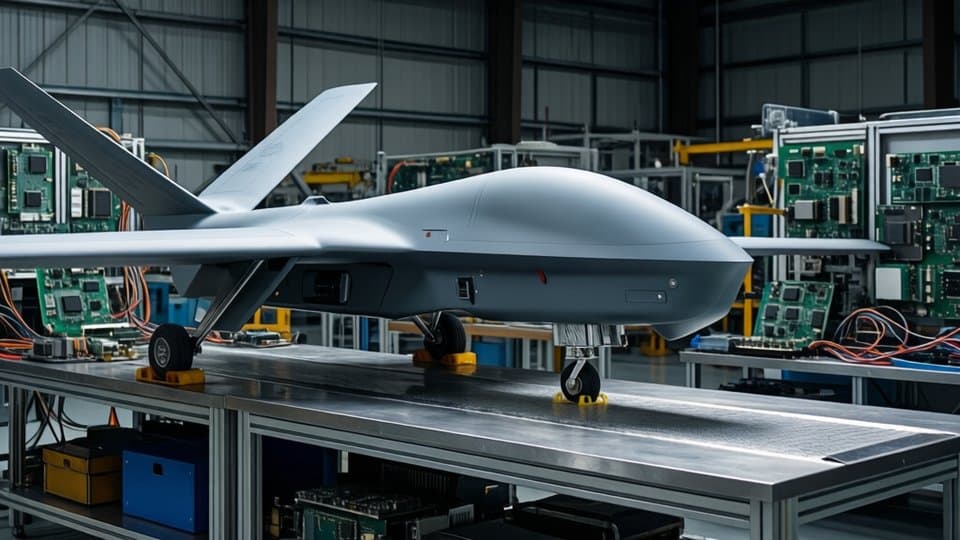
The Pentagon is holding preliminary discussions with General Motors, Ford, and other manufacturers to boost the production of military drones in Asia and globally. These talks aim to utilize automotive assembly lines to supply components like motors, sensors, and lidar to drone makers as the United States seeks to meet massive upcoming demand. This shift matters because it represents a move to secure domestic supply chains and reduce reliance on Chinese-made technology.

  • The Pentagon plans to purchase millions of drones in the coming years, according to SOFX.
  • The U.S. Army is running a competition to produce 400 one-way attack drones for no more than $3,000 each by March 1, according to SOFX.
  • The military drone market could reach $20 billion to $30 billion annually, according to CBT News.

Why is the Pentagon talking to car companies?

The Defense Department wants to scale up the production of unmanned aerial vehicles, including surveillance and one-way attack drones, through its $1.1 billion Drone Dominance Program. While the military needs millions of systems, many current American drone providers are small companies that lack the manufacturing capacity to meet this scale, according to CBT News.

China has led the global drone industry for over a decade and serves as a primary supplier for many parts. This creates national security concerns for U.S. leaders. By involving the automotive industry, the Pentagon hopes to use existing industrial expertise to build a domestic supply chain. The goal is to field hundreds of thousands of one-way attack drones by 2027, as reported by SOFX.

What specific parts could automakers provide?

Automakers are not expected to build complete drones. Instead, they would likely supply essential components to existing drone manufacturers. These parts include engines, actuators, sensors, and lidar, according to SOFX.

General Motors is specifically considering whether to manufacture drone motors that are closer in size to a riding lawn mower motor than a standard car engine, according to CBT News. The automaker has already demonstrated its ability to work with defense firms. In September, GM Defense delivered missile-housing components to Lockheed Martin for the Patriot missile system, completing the task in just 22 days, according to Cardwire.

How each side tells it

The Pentagon and the automakers have different perspectives on the potential for these partnerships. Defense officials see an opportunity to utilize massive industrial scale to ensure military readiness and technological independence from foreign rivals.

Automakers have expressed mixed reactions to these discussions, according to SOFX. Some companies worry about low profit margins on small drones and the uncertainty of annual congressional funding. There are also concerns about the reputational risks of being tied to weapons production.

"GM Defense has extensive capabilities and scale in all aspects of vehicle design, ICE and electric propulsion, and manufacturing, and we have demonstrated our commitment to reinforce the U.S. defense-industrial base and help address critical needs,"

- General Motors statement, via Cardwire.

"Ford has always served the US in times of need. And we have had discussions with the Pentagon,"

- Dave Tovar, Ford spokesperson, via Cardwire.

Which companies are involved in the talks?

General Motors has shown the strongest interest in this defense work so far. The company is discussing potential supply agreements with defense contractors RTX and L3Harris, according to SOFX. Magna International, a Canadian auto parts manufacturer, has also participated in preliminary discussions, though spokesperson Dave Niemiec told Cardwire that the talks are not yet advanced.

Ford is also in discussions with the Pentagon, but the nature of these talks is debated. While SOFX reports Ford is part of the drone component talks, a source told Cardwire that Ford is not currently in active talks regarding drones. Instead, Ford's discussions focus on supplying military vehicles and a minority investment in Revolution Space to manufacture satellites.

What is the history of automakers in defense?

The U.S. automotive industry has a long history of supporting military needs. During World War II, Detroit became the "Arsenal of Democracy" by producing bomber planes and militarized vehicles, according to Cardwire.

Ford provided tactical vehicles during the Korean and Vietnam wars. However, Ford sold its aerospace subsidiary in 1990, which moved its defense work toward companies like Lockheed. General Motors has since re-established its dedicated defense division, GM Defense, in 2017 to participate in modern military contracting.

What happens next?

The immediate focus for the U.S. Army is the Manufacturing Rodeo competition. This program requires selected manufacturers to produce 400 one-way attack drones for a maximum price of $3,000 per unit by March 1, according to SOFX. Manufacturers that succeed in this test could receive orders for up to 10,000 drones.

The Pentagon is also working through a combatant command created by Defense Secretary Pete Hegseth to consolidate drone development. This structure aims to provide larger, more profitable contracts to convince manufacturers to switch factory capacity to defense production.

Frequently Asked Questions

Will car companies start building entire drones?
It is more likely that they will supply specific parts like motors, sensors, and engines to existing drone companies rather than building the full aircraft.

Why can't the military just use existing drone companies?
Many current American drone makers are small and do not have the industrial capacity to produce the millions of units the Pentagon plans to buy.

Is this a move to compete with China?
Yes, the Pentagon wants to reduce its reliance on Chinese supply chains and components for unmanned systems.

Sources

  1. 1.sofx.comPentagon in Talks With Ford, GM to Expand Military Drone Production
  2. 2.cardswire.usatoday.comGM, Pentagon in preliminary talks about making drone parts
  3. 3.ijr.comPentagon reportedly discusses GM, Ford mass drone production
  4. 4.cbtnews.comPentagon looks to GM, Ford and suppliers to scale up drone production

Read more →

Related Articles

North Korean Hackers Use Cheap Meme Coins to Hide Binance Loot
East Asia

North Korean Hackers Use Cheap Meme Coins to Hide Binance Loot

North Korean launderers are creating worthless, disposable meme coins to shuffle stolen funds from the massive Binance hack through decentralized exchanges. By using these tokens as intermediaries, the hackers break the direct on-chain link between their theft and the final receiving wallets, making the movement look like ordinary trading. Between November 5 and November 7, hackers moved roughly 117,000 NEAR, worth about $430,000 , through six new tokens, according to Bitcoin Magazine . The FBI attributed the October 29 Binance theft to the North Korean group TraderTraitor , as reported by News Bitcoin . Approximately 3,000 BTC , valued at about $225 million , has been converted from stolen assets into new bitcoin addresses, according to Blockonomi . How do the hackers use meme coins to hide money? The laundering process relies on a four-step cycle designed to create distance between wallets. First, the North Korean actors mint a new token using public tools. Second, they pair this token with a real asset, such as NEAR or a stablecoin, in a liquidity pool. Third, one group of wallets uses stolen funds to buy the new token from the pool. Finally, a second group of wallets sells the token back into the same pool to collect the real asset. Because the liquidity pool sits in the middle, no stolen funds ever move directly from a buying wallet to a collecting wallet. To an observer, the receiving wallets appear to be nothing more than regular traders cashing out a meme coin for a profit. This method is extremely cheap. Each of the six NEAR tokens identified by Blockonomi cost only about 25 NEAR , or roughly $90 , to create. The hackers can simply repeat this process with new tokens whenever they need to move more money. What kind of tokens are they creating? The tokens used in these operations carry typical meme-coin imagery, including cartoon animals and political figures. One token featured a monkey wearing a pink bow, another showed a duck in front of an American flag, and a third displayed an image of Elon Musk under an "Elon 2028 President" banner. Experts note there is no connection between the billionaire and these tokens. The names of the tokens ranged from crude labels like FUK to variations of popular dog-themed coins, such as SINU . Other names identified in the investigation include OLCCL , MEILI , MMLI , and DABI . These tokens were highly active for only a few hours before being abandoned. On November 8, the creators of four of these tokens withdrew whatever liquidity remained in the pools. The tokens are often linked in a chain. In five of the six cases, the wallet that funded a new token's creator had sold a previous token only 2 to 13 minutes before the next launch. This shows a coordinated, automated sequence of events. Is this a new tactic for North Korea? No, this approach is part of a growing pattern of using cheap, disposable layers to obstruct investigators. The blockchain analytics firm Elliptic first observed this specific technique during the Bybit theft in early 2025, where a worthless Tron token helped move at least $24 million . In the current Binance case, the firm has seen similar variants on the Tron and Solana blockchains. While the technique is effective at creating delays, it does not truly hide the money. Every transaction remains visible on the public blockchain. The goal is not to make the funds invisible, but to buy time. The hackers race to move assets before they are flagged by security services. "Most people think of meme tokens as joke coins whose prices rise and fall on hype. North Korea’s launderers have found a different use for them," stated Dr. Tom Robinson , co-founder and chief scientist at Elliptic. Robinson further explained that North Korean launderers rarely rely on a single method. Instead, they stack many low-cost techniques together to add layers of delay to the investigation. How much money was stolen in the Binance hack? The scale of the theft is massive. The exchange has valued the October 29 attack at roughly $6.34 billion . While the NEAR-based meme coin tactic only accounts for a small fraction of the total, it represents a sophisticated part of a much larger laundering operation involving thousands of wallets and multiple blockchains. The current status of the stolen funds is as follows: Approximately $2.85 billion of the original haul has been frozen, according to Bitcoin Magazine . About $225 million in bitcoin has been moved into new addresses after being converted from other stolen assets. Roughly $43.7 million worth of NEAR, or 11.8 million tokens, has not yet moved. About $15 million worth of ether was traced into Tornado Cash , a crypto mixer. Binance has stated that it covered customer losses using its own funds and has been reopening withdrawals in stages. How do the two sides view the responsibility for the hack? There is a sharp disagreement between Western intelligence agencies and the North Korean government regarding who is behind the theft. The FBI and blockchain firms like Chainalysis have attributed the attack to TraderTraitor , a state-sponsored North Korean hacking group. They point to the sophisticated nature of the attack and the specific patterns of fund movement as evidence of a state-level operation. North Korea has officially denied any involvement. On November 3, Kim Yo-jong , the sister of leader Kim Jong Un , responded to the accusations. She described the claims made by the FBI as a "grave political provocation" designed to damage the reputation of the country. What happens next for investigators? The primary challenge for compliance teams is the speed at which these "homemade" liquidity pools appear. Because the cost to create them is so low, hackers can launch new tokens faster than many automated blacklists can update. Security firms are now warning that funds arriving from a liquidity pool should not be assumed "clean" by default. Investigators will continue to monitor the 11.8 million NEAR that remains stationary and track the movement of the billions in assets that have yet to be fully laundered. The race continues between the automated tools used by the hackers and the blockchain analytics firms trying to freeze the assets. Frequently Asked Questions What is a liquidity pool in crypto? A liquidity pool is a collection of funds locked in a smart contract that allows users to trade one cryptocurrency for another on decentralized exchanges. Why are meme coins being used for crime? They are extremely cheap to create and can be used to create "middleman" steps in a transaction, making it harder to trace the direct path of stolen money. Is the Binance hack still ongoing? The theft occurred on October 29, but the laundering process is ongoing as hackers continue to move and convert the stolen billions across different blockchains. SEO Meta Description: North Korean hackers are using $90 meme coins to launder stolen funds from the $6.3B Binance hack, breaking the direct link between theft and recipient wallets. URL Slug: north-korea-meme-coin-binance-hack-laundering

Tomas Vogel·
Unitree Unveils New Chinese Humanoid Robot for Security and Rescue
Robot Race

Unitree Unveils New Chinese Humanoid Robot for Security and Rescue

What is the new Kung Fu robot bodyguard? Hangzhou-based Unitree Robotics released a promotional video on Wednesday, October 22, 2026, showcasing the H2-X, a chinese humanoid robot designed for security and rescue. The machine, named "Kung Fu Legend: Guardian," performs martial arts, disarms attackers with knives, and lifts vehicles to save trapped individuals. This development signals a push by Chinese firms to move from entertainment-focused machines toward functional, high-stakes security tools. What can the H2-X robot actually do? The H2-X performs complex physical tasks including disarming intruders, smashing car doors, and rescuing pedestrians from oncoming traffic. It demonstrates extreme strength by lifting a car to free a person stuck underneath. The machine also uses martial arts moves to defend people from armed threats. According to geo.tv , the footage shows the robot confronting an armed intruder and performing acrobatic movements. The video highlights the machine's ability to act in emergency scenarios, such as pulling a pedestrian out of the path of an approaching car. These displays aim to prove the robot can handle both combat and heavy lifting tasks. The robot's endurance is a key feature of its design. According to e.vnexpress.net , the manufacturer claims a maximum endurance of approximately eight hours . However, the company has not clarified if this time refers to continuous active movement or simply standing still. How does the H2-X compare to previous models? The H2-X is an advanced evolution of the earlier H2 model, maintaining similar physical dimensions while offering enhanced capabilities. It retains the core structure of its predecessor but focuses on more aggressive and protective functions. This evolution shows the rapid technical progression within the company. The technical specifications for the base H2 model provide context for the new machine's power. According to the South China Morning Post , the H2 stands 1.8 metres tall and weighs roughly 70 kilogrammes . The original H2 features 31 degrees of freedom for joint movement and a maximum leg-joint torque of 360 newton-meters . Unitree Robotics is currently the world's largest humanoid robot manufacturer by sales. By building on the H2 architecture, the company is attempting to transition its hardware from performing dances and somersaults to performing life-saving rescue operations. This shift targets industrial and security sectors rather than just consumer entertainment. Is the robot's performance autonomous or scripted? It is currently unknown if the H2-X acts independently or follows a set program. The manufacturer has not confirmed if the security maneuvers were autonomous, preprogrammed, or controlled by a remote operator. This lack of clarity leaves questions about real-world reliability. There is a significant gap between the promotional footage and real-world application. According to e.vnexpress.net , Unitree has not established whether the robot can independently identify threats and respond safely in unpredictable environments. Without this confirmation, the ability of the machine to distinguish a genuine threat from a harmless situation remains unproven. The company has previously worked on AI to bridge this gap. In September, Unitree introduced the UnifoLM-X2-1.0 AI model. This system was designed to allow robots to practice combat movements like punching, blocking, and dodging autonomously. The company is also developing further AI to help these machines improve through continued learning. Who is the leader behind this technology? Unitree Robotics is led by founder Wang Xingxing , who believes humanoid technology is approaching a massive breakthrough. He views the rapid advancement of artificial intelligence as the primary driver for the next generation of robotic capability. His vision focuses on moving robots into homes and factories. Wang Xingxing recently shared his outlook on the industry at the China International Industry Fair in Shanghai. According to China Daily , he made the following prediction: "humanoid robots could reach a 'ChatGPT moment' within one or two years" Wang Xingxing noted that while the company is already testing robots in automobile factories and residential homes, they still face hurdles. He identified limited efficiency and adaptability as the main barriers preventing widespread adoption of these machines today. What happens next for Unitree and the H2-X? The company has not yet set a release date or announced a price for the H2-X. For now, the focus remains on testing and refining the AI that powers the robot's movements. The industry is watching to see if these machines can move from videos to actual work. While the H2-X is being showcased, the company is also managing safety concerns. Unitree has issued warnings against making dangerous modifications to their machines. They have advised all users to maintain a safety distance of at least two to three metres from the robot during operation. The broader robotics industry in China is under pressure to prove these machines have practical uses. The success of the H2-X will likely depend on whether the company can prove the robot can handle the chaos of a real-world emergency without human intervention. If the predicted "ChatGPT moment" for robotics occurs within the next 24 months, the H2-X could be part of a much larger wave of autonomous machines. Frequently Asked Questions Can the H2-X robot fight humans? The promotional video shows the robot disarming an intruder with a knife and performing martial arts moves. However, it is not yet clear if these actions are autonomous or preprogrammed. How heavy is the Unitree H2-X? The robot is based on the H2 model, which weighs approximately 70 kilogrammes and stands 1.8 metres tall. The specific weight for the H2-X has not been officially disclosed. When can I buy this robot? Unitree has not announced a release date or a price for the H2-X. The robot is currently being showcased through promotional demonstrations.

Kenji Arai·
Global Leaders Gather in Manila for 49th ASEAN Summit
Southeast Asia

Global Leaders Gather in Manila for 49th ASEAN Summit

The Philippines is hosting the 49th Association of Southeast Asian Nations (ASEAN) Summit and Related Summits in Manila from November 15 to 18, 2026, to address regional security and economic resilience. This gathering brings together at least 19 global leaders to discuss the theme "Navigating the Future" and tackle pressing issues like the ongoing crisis in Myanmar. The event highlights the bloc's ability to convene major international powers for dialogue. The summit includes the 23rd ASEAN-India Summit and the 21st East Asia Summit process, according to devdiscourse.com . President Donald Trump and UN Secretary-General Antonio Guterres are expected to attend the gatherings, as reported by thestar.com.my . Chinese Premier Li Qiang will participate in the 29th China-ASEAN Leaders' Meeting in Manila, according to devdiscourse.com . Who is attending the Manila summits? The summit features a massive assembly of heads of state and global institutional leaders. President Ferdinand R. Marcos Jr. chairs the event, which includes leaders from Brunei Darussalam, Cambodia, Indonesia, Lao PDR, Malaysia, Singapore, Thailand, Timor-Leste, and Viet Nam. Myanmar is represented by its Foreign Ministry’s ASEAN Affairs Department Director-General rather than political leaders. Major global players are also participating in the discussions. The thestar.com.my report notes that US President Donald Trump, Canadian Prime Minister Mark Carney, and Brazilian President Luiz Inácio Lula da Silva are expected to be present. Additionally, IMF Managing Director Kristalina Georgieva will join the plenary sessions to discuss economic resilience. India's involvement is also a key component of the schedule. Prime Minister Narendra Modi will attend the 23rd ASEAN-India Summit and the 21st East Asia Summit process. Secretary (East) Rupendra Tandon told devdiscourse.com that the Prime Minister will also meet with the Indian diaspora in the Philippines. How will the Myanmar crisis be addressed? Leaders will use the summit to explore strategies for the Myanmar crisis. The Philippine News Agency reports that sessions will include reviewing the accomplishments of the Philippines' chairship and discussing how to tackle the crisis through dialogue with various sectors, including youth representatives and ASEAN Parliamentarians. The current framework for Myanmar, known as the Five-Point Consensus (5PC), has faced significant challenges. This agreement was adopted following the February 2021 military coup and calls for an immediate end to violence and the provision of humanitarian aid. However, many observers believe the existing framework is no longer sufficient to manage the ground reality. Experts suggest a change in diplomatic approach is necessary. Datuk Dr Ilango Karuppannan, an adjunct professor at Taylor’s University, spoke to Bernama and stated: "Asean should negotiate a new consensus with Myanmar, involving the United Nations, in exchange for Myanmar’s phased reintegration into Asean,” Karuppannan argued that any new agreement must include measurable commitments to reduce violence and improve humanitarian access. He also emphasized that the process should protect the Rohingya and allow refugees to return safely. What are the different views on Myanmar's role? There is a debate regarding how Myanmar should be reintegrated into the bloc. Some suggest that political participation should only be restored once specific, measurable milestones are met. This approach seeks to avoid granting full rights based on mere promises without actual implementation on the ground. How each side tells it: The Analyst's View: Datuk Dr Ilango Karuppannan told Bernama that ASEAN should avoid granting full reintegration upfront and should instead tie the process to implementation and collective agreement. The ASEAN Diplomatic Process: The Philippine News Agency notes that the summit will involve dialogues with various sectors to tackle the crisis, implying a continued, multi-faceted engagement strategy. The role of a special envoy remains a point of discussion. In July, foreign ministers proposed a permanent special envoy to replace the current system of rotating the role annually. Karuppannan noted that a permanent envoy would only be necessary if a new agreement cannot be reached with Myanmar. What is the history of the ASEAN-China relationship? The relationship between ASEAN and China is entering a new phase of cooperation. This year marks the fifth anniversary of the ASEAN-China Comprehensive Strategic Partnership, as reported by devdiscourse.com . Chinese Premier Li Qiang is scheduled to participate in the 29th China-ASEAN Leaders' Meeting in Manila. This visit comes at an invitation from Philippine President Ferdinand Marcos Jr., who currently holds the rotating ASEAN chairmanship. This high-level engagement follows a period of tension, as Chinese Defense Minister Dong Jun was absent from a previous defense gathering in Manila last month. The current summit serves as a platform to strengthen these ties while managing regional security. The East Asia Summit process, which includes eight leaders alongside ASEAN, allows these nations to discuss global security issues in an informal setting. The Philippines, as the current chair, is facilitating these critical dialogues. What are the key economic goals of the summit? The summit focuses heavily on building regional economic resilience. The Department of Foreign Affairs (DFA) stated that the involvement of global leaders like the IMF Managing Director underscores the importance of partnering with major players to achieve this. This aligns with the Philippines' chairship agenda. A central part of this agenda is the Prosperity Corridors initiative. The Philippine News Agency reports that this initiative is a key component of the Philippines' strategy to enhance regional stability and growth. By bringing in international financial and political leaders, the host nation aims to create a more interconnected and stable economic environment. The summit also looks toward the future of collaboration. The theme "Navigating the Future" reflects a focus on how member states can enhance collaboration to become more resilient to global changes. This includes strengthening bilateral and regional partnerships to ensure long-term stability. What happens next? The high-level meetings will begin on November 15 with an opening ceremony at the Philippine International Convention Center (PICC). This will be followed by Plenary and Retreat Sessions where leaders review the accomplishments of the Philippines' chairship. The Related Summits, also known as the Plus One Summits, are scheduled to take place from November 16 to 17. These sessions will be co-chaired by leaders from Australia, China, India, Japan, Korea, New Zealand, Russia, the United Nations, and the United States. The outcome of these talks will likely shape regional security and economic policy for the coming year. Frequently Asked Questions Who is leading the 49th ASEAN Summit? President Ferdinand R. Marcos Jr. of the Philippines is leading the summit as the current ASEAN Chair. Why is the Myanmar crisis a major topic at this summit? The ongoing instability in Myanmar and the stalled Five-Point Consensus require regional leaders to discuss new ways to restore political participation and humanitarian access. Which major global leaders are attending? Expected attendees include US President Donald Trump, Chinese Premier Li Qiang, UN Secretary-General Antonio Guterres, and Indian Prime Minister Narendra Modi.

Sara Lindqvist·