New Humanoid Robot Breaks Usain Bolt's 100m Sprint Record
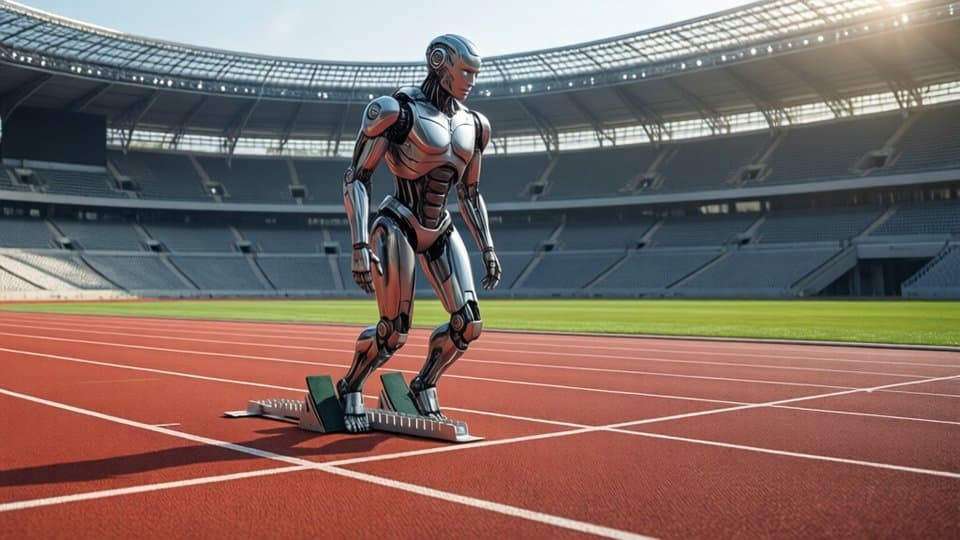
The second World Humanoid Robot Games, held in Beijing from August 22 to 26, 2026, showcased a humanoid robot capable of sprinting faster than the current human 100-meter world record. The event demonstrated rapid advancements in robotic agility through tasks ranging from high jumping to performing traditional martial arts.
- An X-Humanoid robot named TianGong Ultra recorded a 100-meter sprint time of 9.32 seconds, according to Fox News.
- The competition featured 2,056 robots and 666 teams participating in 51 different events, as reported by Fox News.
- A robot achieved a standing high jump of 2.88 meters, surpassing the human record of 2.45 meters, according to Fox News.
How fast can these machines actually run?
Robotic sprinting speeds have improved drastically in just one year. During the 2025 inaugural games, the winning 100-meter robot finished in 21.50 seconds, but this year's top performers broke the 10-second barrier. This leap suggests massive progress in how machines manage their entire bodies during high-speed movement.
The X-Humanoid company reported on August 25 that its TianGong Ultra model reached a time of 9.32 seconds. This is faster than the 9.58-second human record held by Usain Bolt. While these machines do not compete under the same rules as Olympic athletes, the speed highlights new capabilities in motor coordination and sensor integration.
Other machines also showed high performance in different categories. A smaller robot named Tiangong Omni-04 won a 400-meter race with a time of 45.66 seconds, according to AOL. However, the speed comes with risks, as some robots crashed or caught fire during the intense competition.
Can robots perform complex martial arts?
The games have officially moved martial arts from exhibition shows into competitive categories. This year, the competition includes Tai Chi and various self-selected styles such as Baguazhang, Xingyiquan, and Changquan. These matches test how well a machine can balance and move without any human remote control.
According to Beijing Daily, robots must complete their routines autonomously within one to five minutes. They are judged on their ability to perform specific required moves, such as the "spreading wings" pose in Tai Chi. Judges look for "human-likeness, continuity, and stability" to determine the winners.
The scoring system for these matches is quite strict. A base score of 10 points is divided into movement completion, movement quality, and overall performance level. If a robot loses balance or stops moving unexpectedly, it loses points. High-difficulty moves, like a backflip, can earn a robot an extra 7 points under the current rules.
"We hope to see more robots complete high-difficulty moves and achieve precise control."
Zhang Jidong, a technical representative and martial arts referee, noted that interest in these events has grown significantly. While the first games had few participating teams, this year saw 53 teams enter the Tai Chi category alone, according to Beijing Daily.
What are the limitations of this technology?
Despite the record-breaking speeds, the machines still face significant physical and functional hurdles. Many robots struggle with stability during high-speed maneuvers or complex tasks. Some units failed to reach the finish line in races, while others experienced mechanical failures that caused them to break or spark.
Practical work also remains a challenge for these automated systems. In tests involving daily chores like washing and hanging laundry, the machines appeared to work much slower than a typical human. This gap shows that while robots are getting faster at sprinting, they are not yet ready for general domestic labor.
Engineering experts point out that these failures are part of the learning process. The competition provides a way to expose weaknesses that might be hidden in polished promotional videos. By pushing robots to perform weightlifting, tug of war, and soccer, developers can identify where the hardware or software fails under pressure.
Who is organizing these robot games?
The event is a collaborative effort involving both government and specialized organizations. The Beijing Municipal People's Government and the World Robot Cooperation Organization are the primary hosts. Several local departments, including the Beijing Municipal Bureau of Economy and Information Technology, assist with the management of the games.
The games serve a dual purpose for China. They act as a testing ground for the rapidly growing domestic robotics industry and a platform to show the world China's approach to "embodied intelligent robotics." By mixing technology with traditional culture like opera and Tai Chi, organizers aim to attract a global audience.
How does this compare to last year?
The progress between the 2025 and 2026 editions is measurable and steep. The increase in both the number of participants and the technical difficulty of the tasks shows an accelerating development cycle. The industry is moving from simple, stiff demonstrations to systems capable of complex, whole-body control.
The scale of the event has also grown. While the 2025 games were smaller, the 2026 edition saw a massive influx of teams from 16 different countries. This expansion helps create a world-class exchange platform where different developers can compare their progress and find new ways to solve technical problems.
What happens next?
The immediate focus for developers will be improving the reliability of these machines during physical tasks. Following the conclusion of the August 26 games, engineers will likely analyze the data from the failed runs and mechanical breakdowns to improve the next generation of hardware. The industry will continue to push for better "whole-body control" to ensure robots can move smoothly without the sparks or falls seen in Beijing.
Frequently Asked Questions
Did a robot actually beat Usain Bolt's record?
A robot named TianGong Ultra ran 100 meters in 9.32 seconds, which is faster than Bolt's 9.58-second record, but these are separate competitions with different rules.
Are these robots used in homes yet?
No, current testing shows that while they can sprint fast, they still lag behind human speeds in practical tasks like laundry and housework.
What are the robots being tested for?
They are being tested for speed, strength, and stability in tasks ranging from sports and martial arts to real-world jobs and industrial applications.
Sources
- 1.arstechnica.comWorld humanoid robot games show runners breaking records, bursting into flames
- 2.global.chinadaily.com.cn2025 World Humanoid Robot Games open in Beijing
- 3.foxnews.comHumanoid robot outruns Usain Bolt record as China races ahead
- 4.aol.comBeijing Robot Games: humanoids take on sprints, football and tai chi
- 5.bjd.com.cn人形机器人正式比武!太极拳“白鹤亮翅”是必选动作