Siemens uses AI to design a humanoid robot gripper
Siemens is demonstrating a new industrial workflow at Formnext 2026 that uses an AI agent to design a humanoid robot gripper based on simple text descriptions. By connecting prompt-based engineering with adaptive manufacturing, the German technology group aims to automate the transition from a written idea to a physical, 3D printed part.
- Siemens is partnering with Shanghai-based AGIBOT to demonstrate this agentic AI engineering workflow.
- The system uses Model Context Protocol integration to allow the AI to control engineering software functions.
- An adaptive production cell is being built at the Siemens Electronics Factory in Erlangen, Germany.
How does the AI design the robotic part?
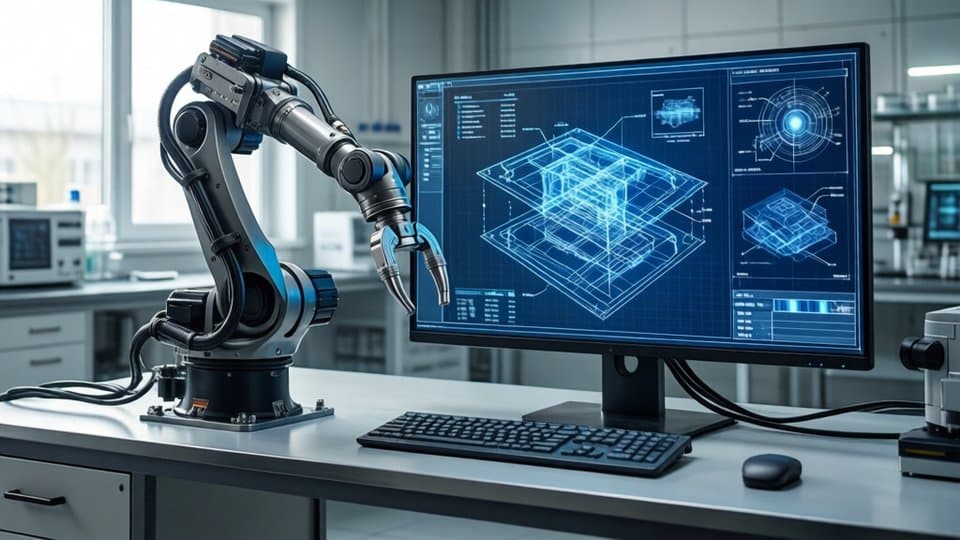
The process begins when a user provides a natural language description of an object and the specific task a robot must perform. Instead of an engineer manually using various software tools to create a design, the AI agent takes over the technical orchestration.
According to 3dprintingindustry.com, the agent selects a suitable gripper type and adapts its geometry within Siemens Designcenter. The agent then runs simulations to validate the robot interface and the handling capabilities. Once the design is virtually verified, the workflow prepares the necessary data for additive manufacturing.
This method moves engineering away from manual tool manipulation toward prompt-based instructions. Automation.com reports that this could allow people without deep expertise in every specific engineering tool to participate in complex product development.
What is the goal of the adaptive production cell?
While AI can speed up design, manufacturing customized parts often creates bottlenecks in traditional factories. Siemens is addressing this by developing an adaptive production cell at its Electronics Factory in Erlangen, Germany, in collaboration with EOS and AM Solutions.
The cell integrates additive manufacturing, automation, and software into a single process chain. The objective is to handle diverse component requirements while maintaining the ability to scale production. 3D Adept notes that the cell is designed to manage different parts and changing production needs without losing repeatability.
Post-processing is a major focus of this new setup. Intelligent CIO explains that the project incorporates automated post-processing from the start to prevent the finishing stages from becoming production delays.
How do the partners view this technology?
The partners involved in the project see this as a fundamental shift in how industrial goods are made. They view the combination of AI and 3D printing as a way to move beyond the rigid, standardized production models of the past.
David Soldan, Head of AM Solutions 3D Post Processing Technology, emphasizes that the process is not finished once the print ends. He states that downstream processing must be integrated to manufacture components efficiently at scale.
What is the background of this technology?
The push for industrial AI is part of a broader movement to create a "Digital Thread" that connects every stage of a product's life. This involves linking design, simulation, and manufacturing preparation into one continuous data stream.
To help companies adopt these tools, Siemens enhanced its AM I Navigator with industrial AI capabilities. This tool was originally launched in 2023 alongside partners like HP and BASF Forward AM. It helps businesses identify where AI can be applied in their design and production workflows to create a roadmap for scaling.
Other companies are also moving in this direction. For example, 3dprintingindustry.com reports that Synera uses AI agents to automate file repair and slicing, while Ai Build has introduced "Talk to AI" features to accept text instructions for print preparation.
What happens next?
Siemens is moving from demonstration to real-world application by building the adaptive production cell within its own electronics factory. This allows the company to test the AI-driven workflow in a live industrial environment.
The full workflow, including the AI-designed gripper, is being exhibited at the Formnext 2026 event in Frankfurt. Following this, the focus will shift to refining how these intelligent systems handle quality, traceability, and security in large-scale industrial settings.
Frequently Asked Questions
What is an AI agent in manufacturing?
An AI agent is a software tool that can interpret instructions and autonomously coordinate multiple steps in an engineering or production workflow.Why use 3D printing for robot grippers?
3D printing allows for unique, custom geometries that can be quickly changed to suit different objects, which is more efficient than traditional manufacturing for small, specialized batches.Can anyone use this AI engineering tool?
Siemens suggests the tool could make complex workflows accessible to more users because they will not need to master every individual piece of engineering software manually.SEO Meta Description: Siemens and AGIBOT demonstrate an AI agent that designs 3D printed humanoid robot grippers using text prompts to automate complex engineering workflows.
URL Slug: siemens-agibot-ai-agent-3d-printed-robot-gripper-design
Sources
- 1.3dprintingindustry.comSiemens and AGIBOT Show AI Agent That Designs 3D Printed Humanoid Robot Grippers from a Text Prompt
- 2.automation.comSiemens combines industrial AI and additive manufacturing for adaptive product development and production
- 3.3dadept.comSiemens uses Agentic AI to automate additive manufacturing workflows
- 4.intelligentcio.comSiemens brings agentic AI into industrial manufacturing